Tinggalkan Pesan
Jika Anda tertarik dengan produk kami dan ingin mengetahui detail lebih lanjut, silakan tinggalkan pesan di sini, kami akan membalas Anda sesegera mungkin.

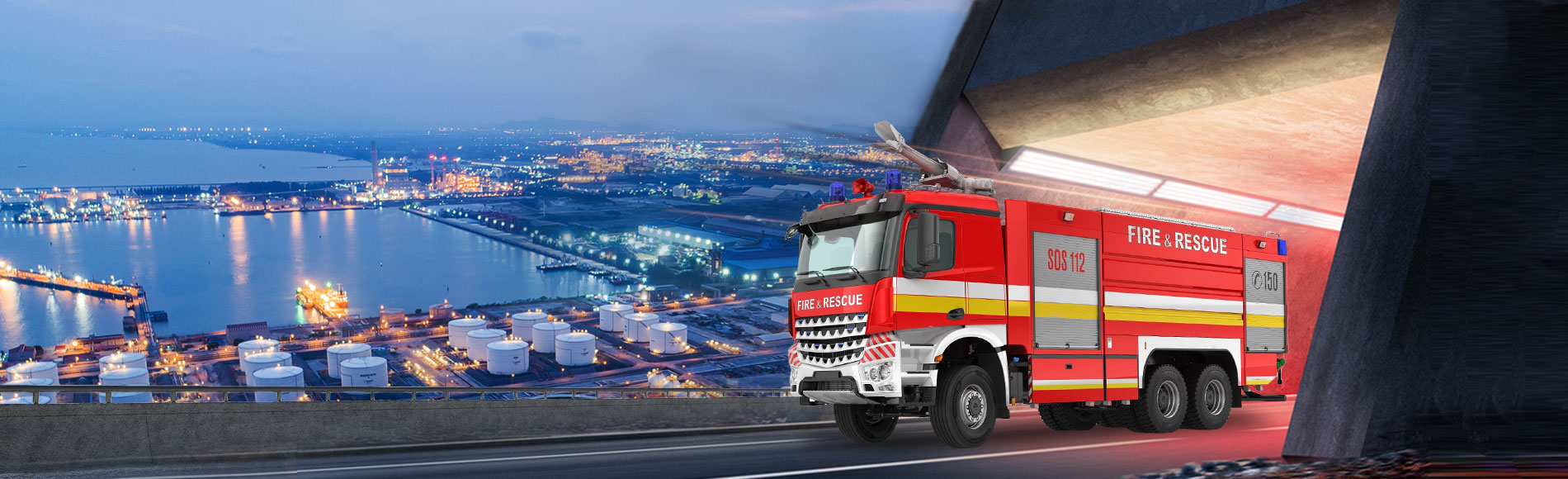
Fire Truck Water Tank Materials Comparison: Carbon Steel vs Stainless Steel vs Aluminum
During fire apparatus procurement, our customers typically prioritize chassis performance, fire pump flow and pressure ratings, and firefighting system configuration. However, the choice of fire truck water tank material is equally important, as it directly affects the vehicle's service life, corrosion resistance, maintenance cost, and long-term operational reliability.
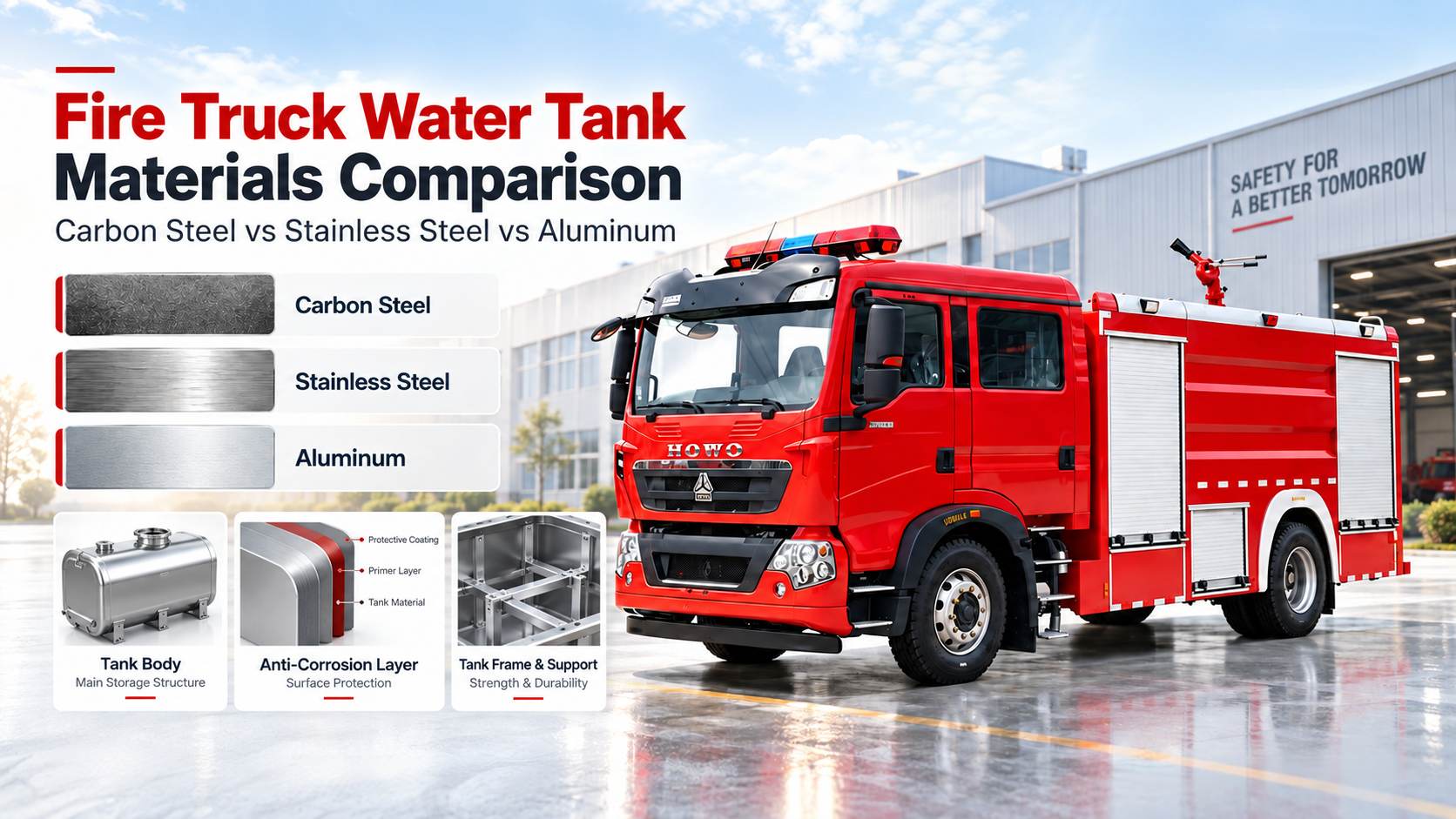
As a professional fire truck manufacturer, we understand that water tank material selection is not merely a price comparison, but a comprehensive engineering decision. This article compares the three most common fire truck water tank materials—carbon steel, stainless steel, and aluminum—based on engineering requirements, real-world performance, and lifecycle cost.
I. Structure of a Fire Truck Water Tank
Before comparing materials, it is important to understand that a water tank is not simply a container for water. A modern apparatus water tank is a pressure-bearing and surge-suppressing structure integrated into the vehicle body. It must withstand fill pump pressure, water surge during braking and cornering, road vibration, and chemical attack from firefighting foam and reclaimed water.
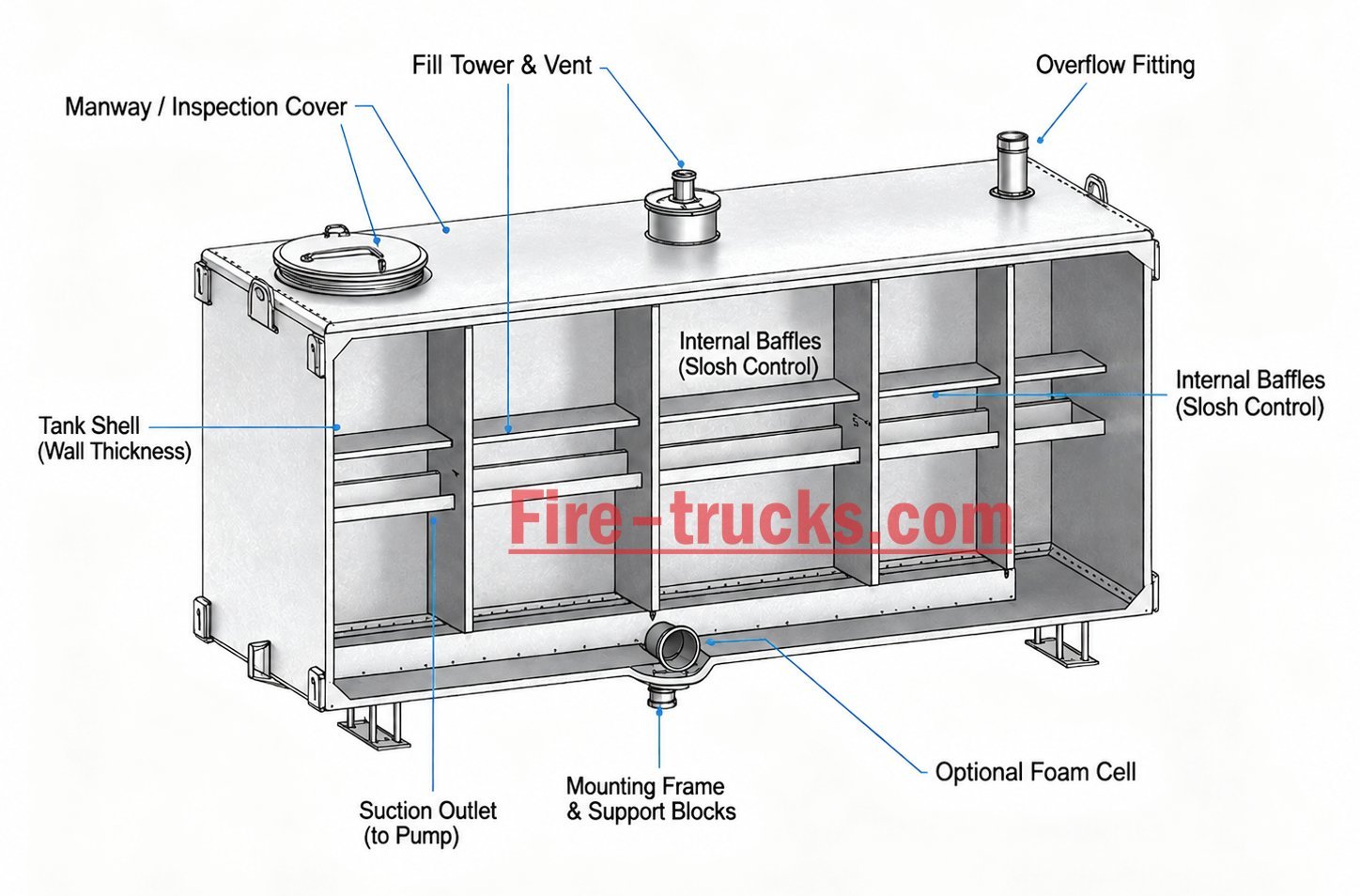
Typical internal and external features include:
• Internal baffles — welded partitions that suppress water surge and stabilize vehicle handling
• Fill tower and vent — top fill opening with vent to prevent vacuum or pressure lock
• Manhole / inspection cover — sealed opening for personnel access for internal inspection and cleaning
• Pump suction port — connection that delivers water from the tank to the fire pump
• Overflow port — prevents over-pressurization during filling
• Mounting brackets and support blocks — isolate chassis twisting; slotted mounts allow thermal expansion and contraction
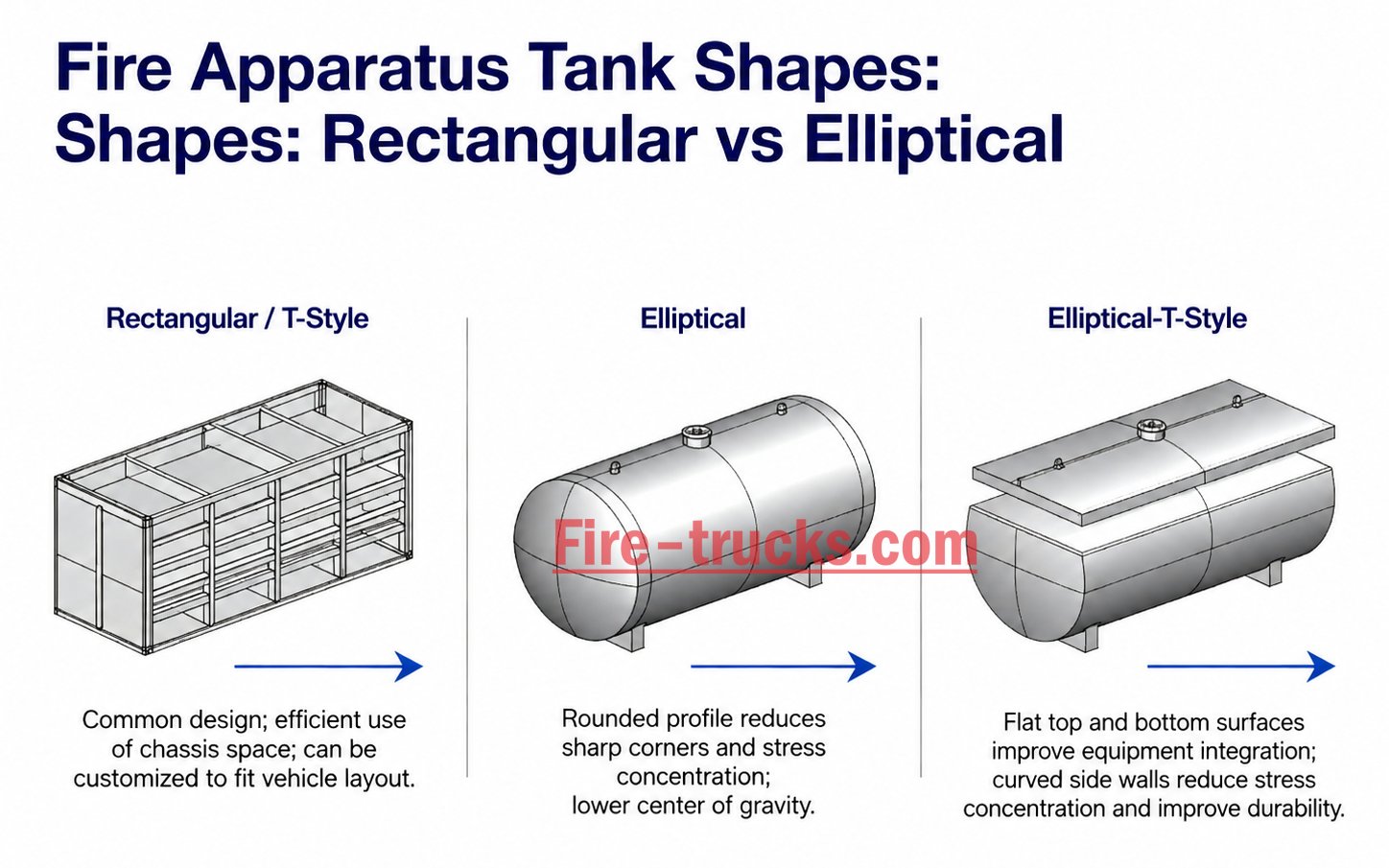
Water tanks are available in rectangular/T-shaped and elliptical configurations. Elliptical tanks have no sharp corners where welding stress concentrates, but they have a higher center of gravity and often require stainless steel cladding for appearance. Tank material is closely related to these features—welds, baffles, and connections—not just the exterior surface.
II. Three Key Materials Used in Fire Truck Water Tanks
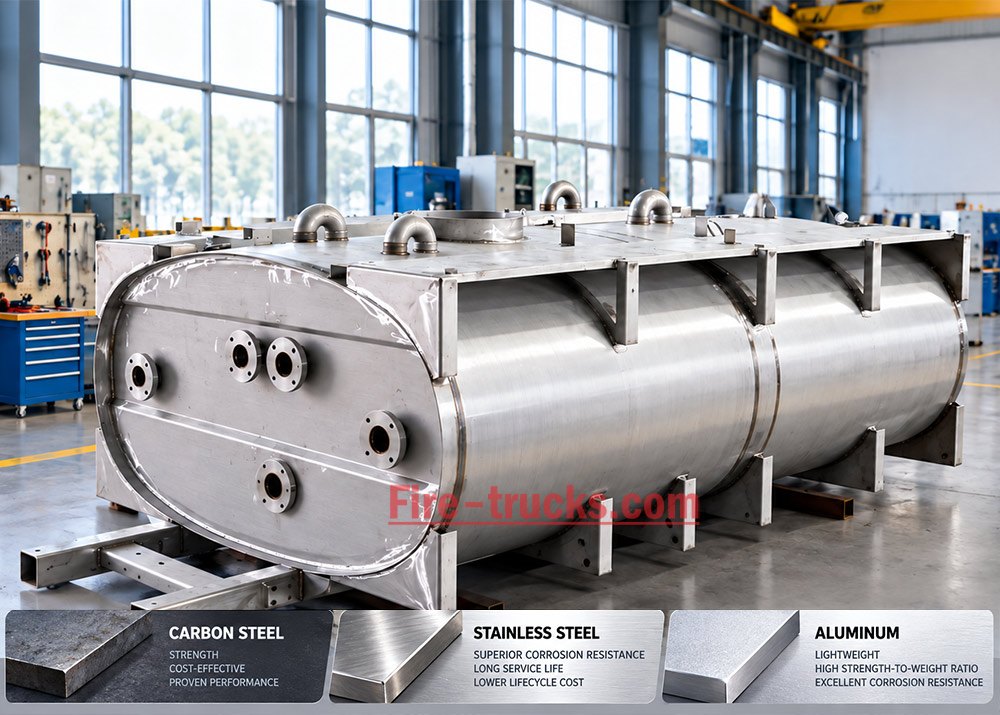
1. Carbon Steel
Typically Q235B or Q345R, with internal epoxy coating. High strength, mature welding processes, low cost, but requires regular coating maintenance and has a shorter service life (5–8 years).
• Lowest initial material and manufacturing cost
• Easy to weld, cut, and repair in the workshop
• Heaviest option, reducing payload capacity
• Requires internal and external coating (epoxy, galvanized, or paint)
• Coating damage leads to rapid pitting of bare steel
2. Stainless Steel
Typically SUS304 or SUS316L. Excellent corrosion resistance, long service life (15+ years), hygienic surface, but higher initial cost and requires careful welding practices.
• Self-repairing chromium oxide (Cr₂O₃) film
• No internal coating required
• Highest material cost
• Brushed or mirror finish suitable for exposed appearance
• Requires attention to cracking and microbiologically influenced corrosion
3. Aluminum
Typically marine-grade 5083 alloy. Lightweight (one-third the density of steel), naturally corrosion-resistant, excellent fatigue resistance, but lower strength and requires specialized fabrication.
• Density approximately one-third that of steel
• Natural Al₂O₃ film resists atmospheric corrosion
• Excellent strength-to-weight ratio, suitable for aerial ladders
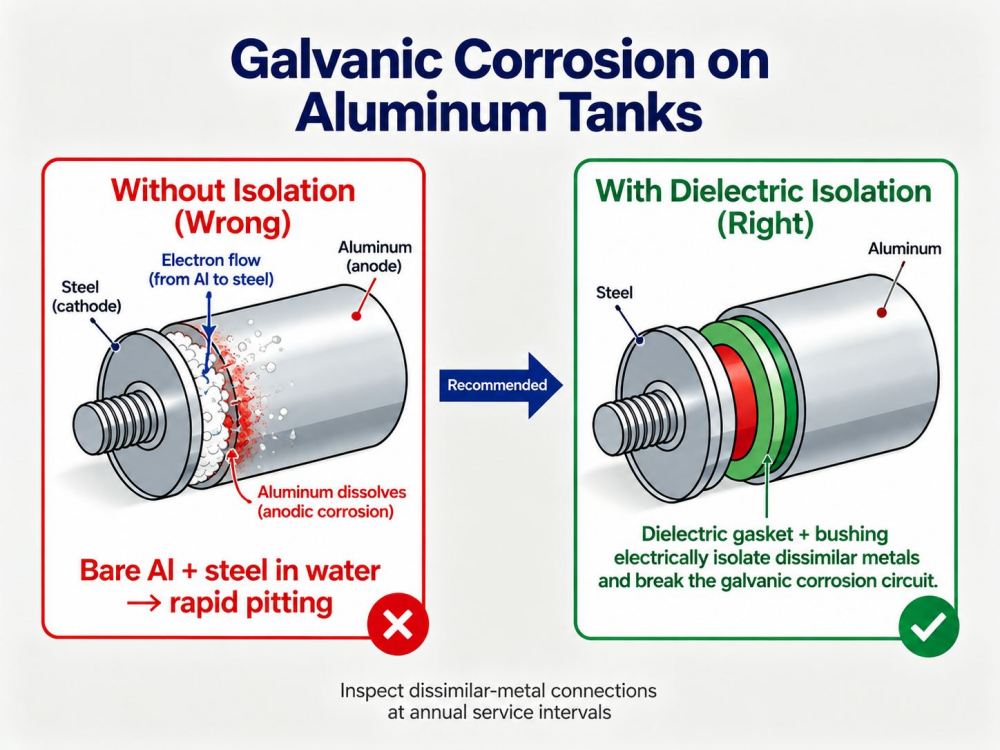
• Galvanic corrosion risk when connected to steel fittings
• Lower impact toughness than steel
III. Corrosion Resistance
The difference between the three materials is essentially a story of surface chemistry. The following describes what happens at the metal-water interface for each material.
Carbon steel: Bare carbon steel rusts rapidly when exposed to water. It must be protected by an internal anti-corrosion coating, typically epoxy resin or polyurethane. If the coating is scratched or degraded, the underlying steel corrodes, and rust particles can be washed into the fire pump and damage the impeller.
Stainless steel: Forms a passive chromium oxide layer that resists rust and chemical attack. SUS304 is suitable for freshwater storage, while SUS316L—containing molybdenum—offers superior resistance to chloride-induced corrosion, making it suitable for coastal areas or chlorinated water sources. However, if fabrication quality is poor, stainless steel can still corrode at weld seams and heat-affected zones.
Aluminum: Forms a protective oxide layer that resists corrosion, eliminating the need for internal coating. However, when connected to dissimilar metals (such as steel or brass fittings), galvanic corrosion can occur. Cathodic protection and protective coatings are recommended at connection points.
IV. Mechanical Strength and Stiffness
Carbon steel: Offers excellent mechanical strength and stiffness, making it suitable for large-capacity tanks where structural rigidity is critical. Yield strength is typically around 350 MPa.
Stainless steel: Achieves a good balance between strength and corrosion resistance, with tensile strength typically around 540 MPa.
Aluminum: Has lower yield strength and tensile strength than carbon or stainless steel, which may limit its use in very large tanks or high-stress applications. Yield strength is typically around 275 MPa.
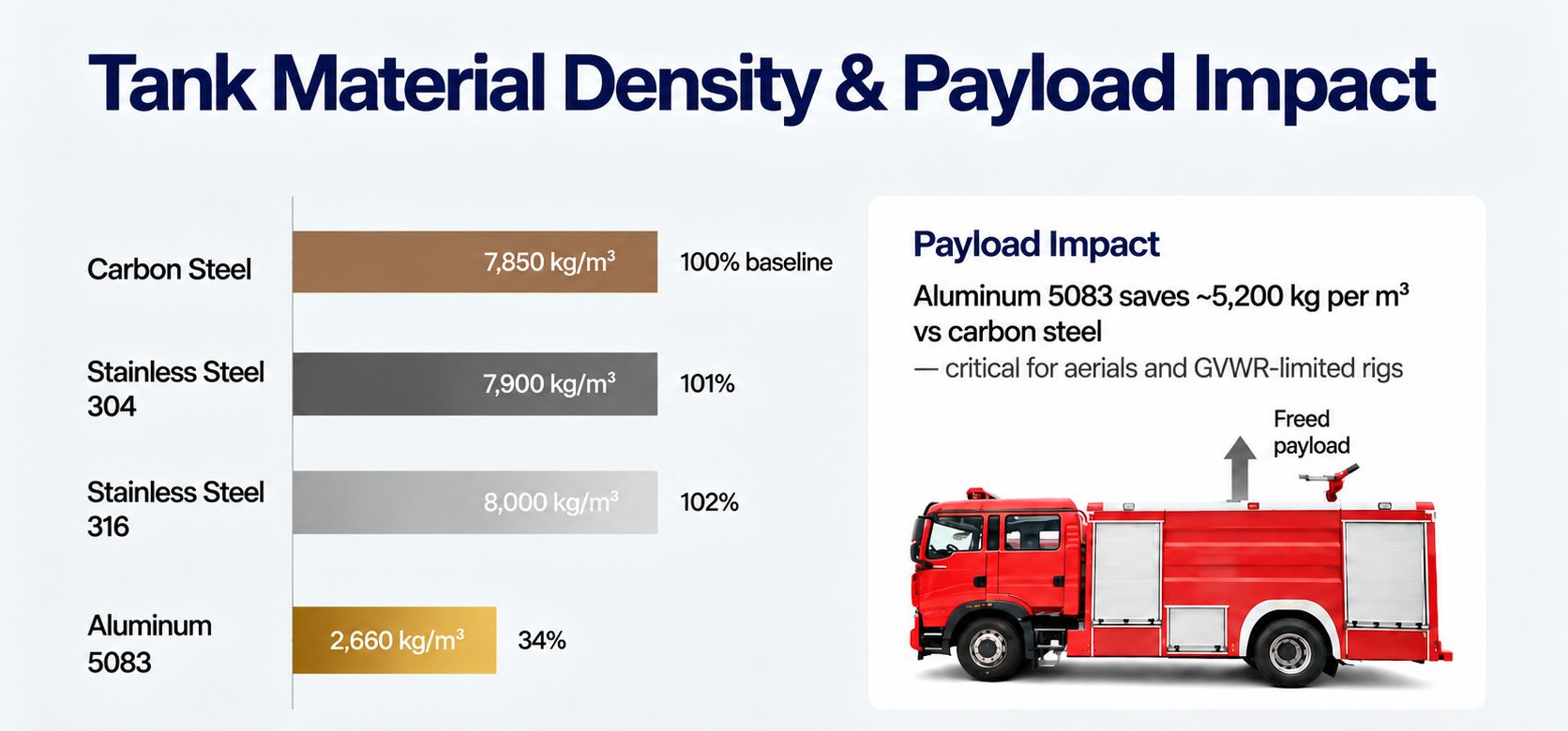
V. Weight and Payload Impact
Carbon steel: Density of 7.85 g/cm³. Heavy, but strength allows for thinner plates in some applications.
Stainless steel: Density of approximately 8 g/cm³. Similar weight to carbon steel.
Aluminum: Density of 2.7 g/cm³—roughly one-third that of steel. This directly translates to increased payload capacity or reduced fuel consumption, making it ideal for weight-sensitive applications.
VI. Service Life and Maintenance
Carbon steel: 5–8 years with proper coating maintenance. Requires regular inspection (every 6 months) and coating repair. Shorter service life means higher replacement frequency.
Stainless steel: 15+ years with proper maintenance. Low maintenance burden. The smooth interior surface resists algae and bacterial growth.
Aluminum: 15–20 years in demanding environments. No internal coating required, but requires inspection of welds and dissimilar metal connections.
The choice of fire truck water tank material is not a simple price comparison, but a lifecycle cost decision based on water quality, operating environment, payload requirements, and maintenance capability.
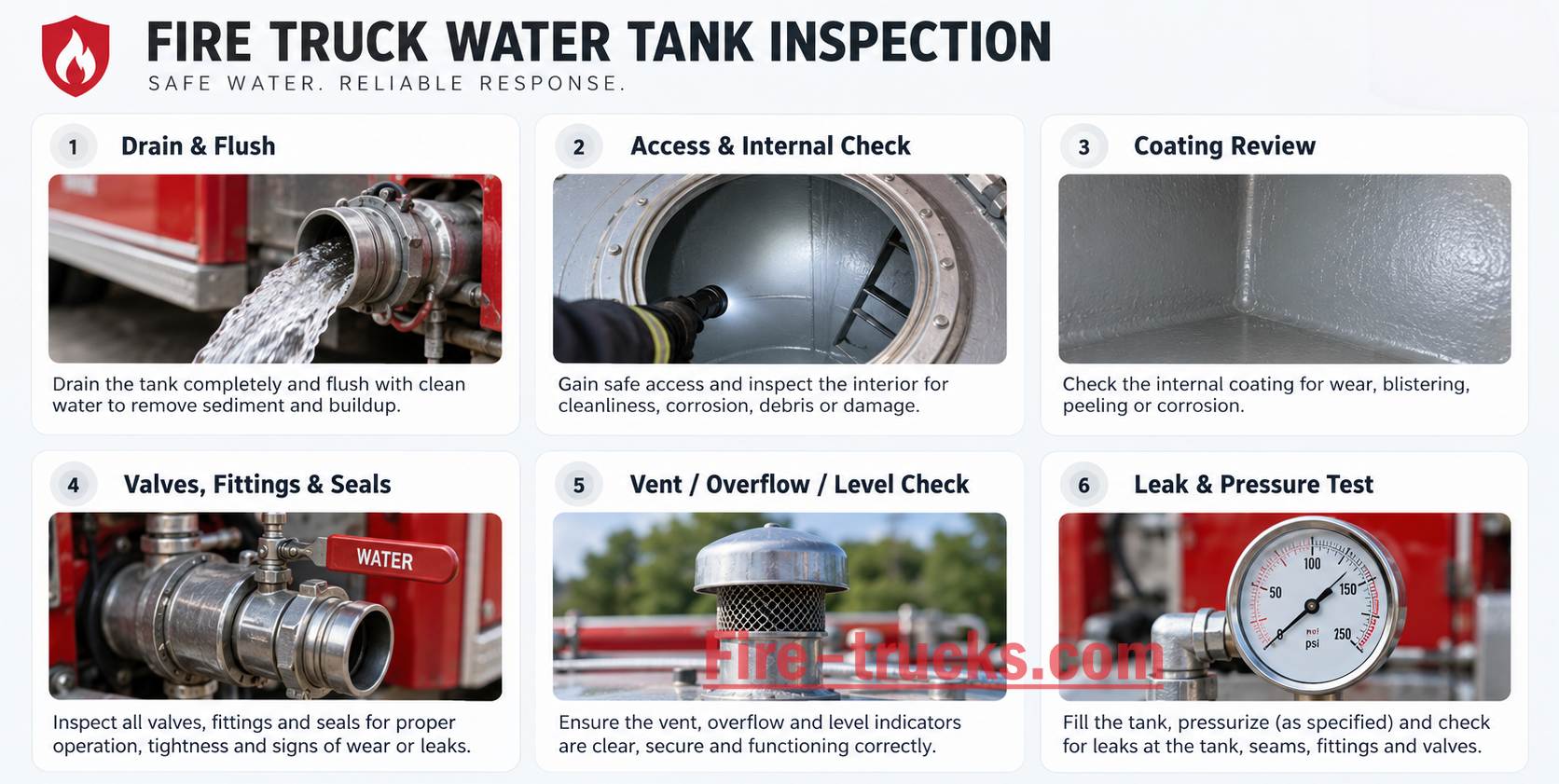
How to Maintain a Fire Truck Water Tank & Checklist
1. Drain all remaining water after each shift to prevent freezing cracks in winter.
2. Flush the tank and pipes immediately after using unclean water sources.
3. Check seals, tank leaks, and valve operation weekly.
4. Drain and remove sediment and scale from the tank monthly.
5. Clean the interior and inspect welds yearly; sand rust spots and apply epoxy resin paint.
6. Replace stored water regularly to prevent deterioration and corrosion.
VII. Fire Truck Tank Material Performance Comparison Table
| Item | Carbon Steel | Stainless Steel | Aluminum |
| Cost | Low | High | Moderate |
| Weight | Heavy | Moderate | Lightweight |
| Corrosion Resistance | Fair | Excellent | Good |
| Strength | Excellent | Excellent | Good |
| Maintenance Requirement | High | Low | Moderate |
| Manufacturing Difficulty | Low | Moderate | High |
| Service Life | Moderate | Long | Long |
Which Material Should You Choose?
• Choose carbon steel: For budget ground pumpers in dry inland climates, where the fleet has an active maintenance program and commits to annual internal inspection and coating repair.
• Choose stainless steel (304): For standard municipal apparatus requiring a coating-free, low-maintenance shell with a clean appearance; specify 316 for coastal, salt-spray, or chemical environments.
• Choose aluminum (5083): For aerial ladder trucks where every pound of tank weight saved translates into useful payload—provided that electrical isolation at all steel-aluminum connections is verified on the production line.
VIII. Frequently Asked Questions (FAQ)
Q1: How often should the inside of a water tank be inspected?
A: Coated carbon steel tanks should be inspected every 6 months, while stainless steel and aluminum tanks should be inspected annually. If natural water sources, foam concentrate, or coastal operations are common, the inspection interval should be shortened accordingly. Results should be recorded after each inspection to establish a maintenance file.
Q2: What is the difference between SUS304 and SUS316L for fire truck tanks?
A: SUS304 is suitable for freshwater storage and inland operations. SUS316L contains molybdenum, which significantly improves resistance to chloride-induced pitting corrosion. If you operate in a coastal environment or use high-chloride water sources, SUS316L is the better choice. For inland departments using municipal water, SUS304 is generally sufficient.
Q3: Do aluminum fire truck tanks need internal coating?
A: No. Aluminum naturally forms a protective oxide layer that resists corrosion, eliminating the need for internal coating. This is one of the main advantages of aluminum tanks—it removes the coating maintenance requirement that carbon steel tanks have. However, aluminum tanks still require isolation measures at dissimilar metal connections to prevent galvanic corrosion.
Q4: Which fire truck tank material is best for coastal areas?
A: For coastal areas, choose either stainless steel SUS316L or aluminum. SUS316L contains molybdenum, which resists chloride-induced pitting corrosion. Aluminum naturally resists salt spray corrosion and requires no internal coating. SUS304 should be avoided in coastal environments unless additional protective measures are taken, as chloride-rich air and water can cause pitting corrosion over time.
Q5: Why do stainless steel fire truck tanks sometimes rust?
A: Stainless steel corrosion typically occurs at weld seams, heat-affected zones, or areas contaminated with iron during fabrication. High-chloride water can also cause pitting corrosion. Proper welding (continuous, cleaned), surface protection during fabrication, and optional internal coating can prevent this. If you operate in a coastal area, specify SUS316L instead of SUS304 for better chloride resistance.
Q6: How long does a fire truck water tank last?
A: Service life depends on the material: carbon steel tanks last 5–8 years with proper coating maintenance; stainless steel tanks last 15+ years; aluminum tanks last 15–20 years. Actual service life is also affected by water quality, operating environment, and maintenance practices.
IX. Conclusion
The choice of fire truck water tank material is not a simple price comparison, but a lifecycle cost decision based on water quality, operating environment, payload requirements, and maintenance capability:
Water quality → Operating environment → Payload priority → Maintenance capability → Material selection
• Carbon steel: Lowest upfront cost, high strength, but requires diligent coating maintenance and has the shortest service life (5–8 years)
• Stainless steel: Industry standard, excellent corrosion resistance, long service life (15+ years), low maintenance—the safest default choice for most fire departments
• Aluminum: Lightest option, natural corrosion resistance, excellent fatigue resistance—ideal for payload-sensitive, coastal, and high-duty applications


Anda mungkin tertarik dengan informasi berikut
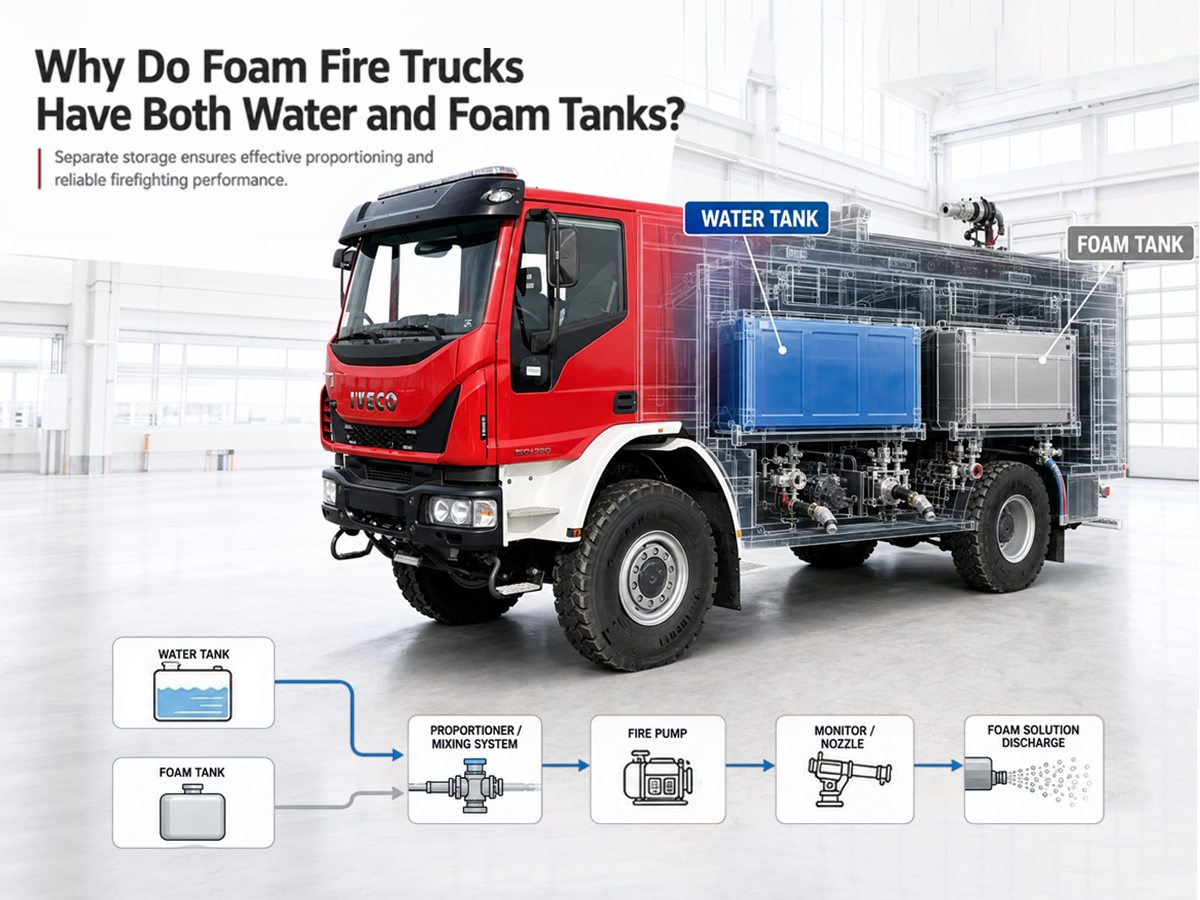
Truk pemadam kebakaran busa menggabungkan tangki konsentrat busa khusus dengan tangki air terpisah dan sistem proporsi presisi. Mereka menggunakan sistem proporsi untuk memasukkan konsentrat busa ke dalam aliran air pada konsentrasi tertentu, umumnya 1%, 3%, atau 6%, tergantung pada jenis konsentrat busa dan aplikasi pemadaman kebakaran.tangki gandaDesain ini memungkinkan petugas pemadam kebakaran untuk hanya menggunakan air ketika busa tidak diperlukan dan hanya menggunakan konsentrat busa bila dibutuhkan. Hal ini meningkatkan fleksibilitas operasional, membantu mengendalikan konsumsi busa, dan memungkinkan sistem pemadam kebakaran dikonfigurasi untuk berbagai bahaya kebakaran. Prinsip kerja inti dan teknologi utama truk pemadam kebakaran busa, khususnya mengapa truk tersebut memiliki tangki air dan busa, menjadi fokus banyak pelanggan. Mari kita pelajari hal ini hari ini. Jawaban Singkat: Truk pemadam kebakaran busa biasanya menggunakan tangki air dan konsentrat busa terpisah karena air dan konsentrat busa dibutuhkan dalam proporsi yang berbeda dan dimaksudkan untuk digabungkan selama operasi, bukan disimpan sebagai larutan campuran untuk jangka waktu lama. Tangki air menyediakan pasokan air utama, sedangkan tangki busa menyimpan zat busa pekat. Sistem pengaturan proporsi mengontrol seberapa banyak konsentrat yang dimasukkan ke dalam aliran air, memungkinkan truk untuk beralih antara mode pemadaman air saja dan mode pemadaman busa. SAYA. Apa Saja Komponen Utama dari Truk Pemadam Kebakaran Busa? 1. Tangki Air Konstruksi tahan korosi (baja karbon dengan lapisan anti korosi atau baja tahan karat), kapasitas mulai dari 4.000 hingga 6.000 liter. Dilengkapi dengan sekat untuk mengurangi gejolak cairan selama pergerakan kendaraan dan dudukan fleksibel untuk menyerap lenturan sasis di medan yang kasar. 2. Tangki Konsentrat Busa Konstruksi baja tahan karat untuk menahan serangan kimia dari konsentrat busa aktif, biasanya berkapasitas 500-2.000 liter. Tergantung pada konsentrat busa dan desain sistem, tangki dapat dilengkapi dengan fitur-fitur seperti pengaturan sirkulasi atau pengadukan untuk membantu menjaga kondisi konsentrat selama penyimpanan. 3. Sistem Proporsi Busa Sistem proporsi yang mengambil konsentrat busa dari tempat khusus.busatangki dan memasukkannya ke dalam aliran air pada konsentrasi tertentu. Tergantung pada konsentrat busa dan desain sistem, proporsi dapat menggunakan teknologi tekanan seimbang, penggerak pompa, atau berbasis venturi. 4. Pompa Pemadam Kebakaran Pompa pemadam kebakaran adalah sumber tenaga dari seluruh sistem busa. Pompa ini mengambil air dari tangki air dan memberi tekanan pada air tersebut hingga mencapai laju aliran dan tekanan yang dibutuhkan untuk operasi pemadaman kebakaran. Pompa biasanya digerakkan oleh power take-off (PTO) kendaraan atau mesin independen, dan harus kompatibel dengan sistem proporsi untuk memastikan injeksi konsentrat busa yang akurat pada berbagai laju aliran. Konfigurasi umum meli...
Detail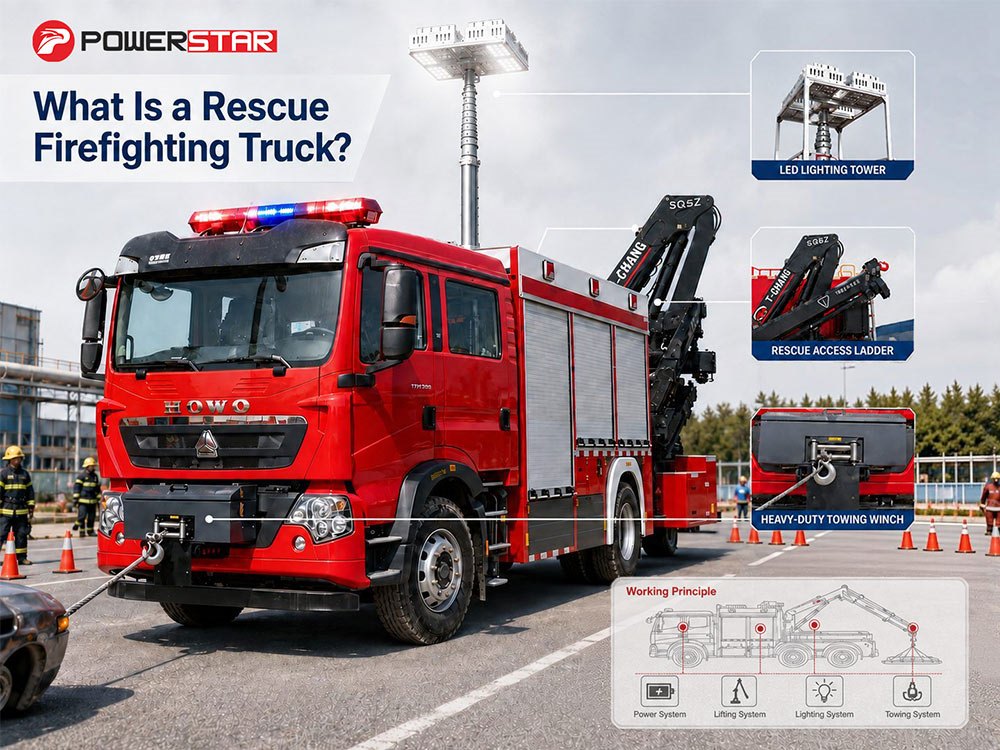
Truk pemadam kebakaran penyelamat adalah kendaraan darurat khusus yang dirancang untuk melakukan pemadaman kebakaran dan operasi penyelamatan. Tidak seperti truk pemadam kebakaran standar yang fokus utamanya pada pemadaman kebakaran,truk pemadam kebakaran penyelamatMenggabungkan peralatan pemadam kebakaran dengan alat penyelamatan, alat pengangkat dan pengerek, alat pemotong dan penyebar, derek, generator, dan sistem penerangan. Artikel ini menjelaskan apa itu truk pemadam kebakaran penyelamat, bagaimana perbedaannya dengan kendaraan pemadam kebakaran lainnya, peralatan apa yang dibawanya, dan kapan truk tersebut dikerahkan. I. Apa Itu Truk Pemadam Kebakaran Penyelamat? Truk pemadam kebakaran penyelamat adalah kendaraan darurat serbaguna yang menggabungkan kemampuan pemadaman kebakaran dengan peralatan penyelamatan khusus. Kendaraan ini terutama digunakan untuk memberikan kemampuan respons darurat yang komprehensif ketika terjadi insiden yang melibatkan orang, kendaraan, bangunan, atau fasilitas industri. Tergantung pada konfigurasi kendaraan, truk pemadam kebakaran penyelamat dapat dilengkapi dengan berbagai macam alat penyelamat dan sistem pemadam kebakaran. Pemilihan peralatan sebenarnya bervariasi berdasarkan tujuan penggunaan kendaraan. Misalnya, kendaraan yang dikonfigurasi untuk penyelamatan perkotaan mungkin memiliki tata letak peralatan yang berbeda dari kendaraan yang dirancang untuk penyelamatan industri, penanggulangan gempa bumi, atau pemulihan kecelakaan lalu lintas di jalan raya. II. Peralatan Apa Saja yang Dibawa oleh Truk Pemadam Kebakaran Penyelamat? Perlengkapan yang dibawa pada truk pemadam kebakaran penyelamat bergantung pada desain kendaraan dan tujuan penggunaannya. Namun, perlengkapan pada sebagian besar model dapat dikelompokkan ke dalam beberapa kategori utama: peralatan pemadam kebakaran, alat penyelamat, peralatan tenaga, peralatan penerangan, alat pengangkat dan penarik, serta perlengkapan pelindung diri. 1. Peralatan Pemadam Kebakaran Peralatan pemadam kebakaran dapat mencakup alat pemadam api, selang pemadam api, nosel pemadam api, pompa portabel, tangki air, sistem pemadam api busa, monitor api, dan alat pemadam lainnya. 2. Alat Penyelamatan Hidraulik Peralatan penyelamatan hidrolik umumnya digunakan dalam operasi penyelamatan kecelakaan lalu lintas untuk memotong, melebarkan, atau mengangkat struktur kendaraan yang rusak. Peralatan umum meliputi pemotong hidrolik, pelebar hidrolik, dan dongkrak hidrolik. 3. Generator Listrik Generator menyediakan daya listrik untuk peralatan penyelamatan, peralatan penerangan, perangkat komunikasi, dan peralatan lainnya ketika tidak ada sumber daya listrik eksternal yang tersedia di lokasi kejadian. 4. Peralatan Pencahayaan Sistem penerangan darurat membantu petugas penyelamat beroperasi di malam hari, di dalam gedung, di jalan raya, dan dalam kondisi pencahayaan rendah lainnya. 5. Derek dan Peralatan Penarik Beberapa truk pemadam kebakaran penyelamat dapat...
Detail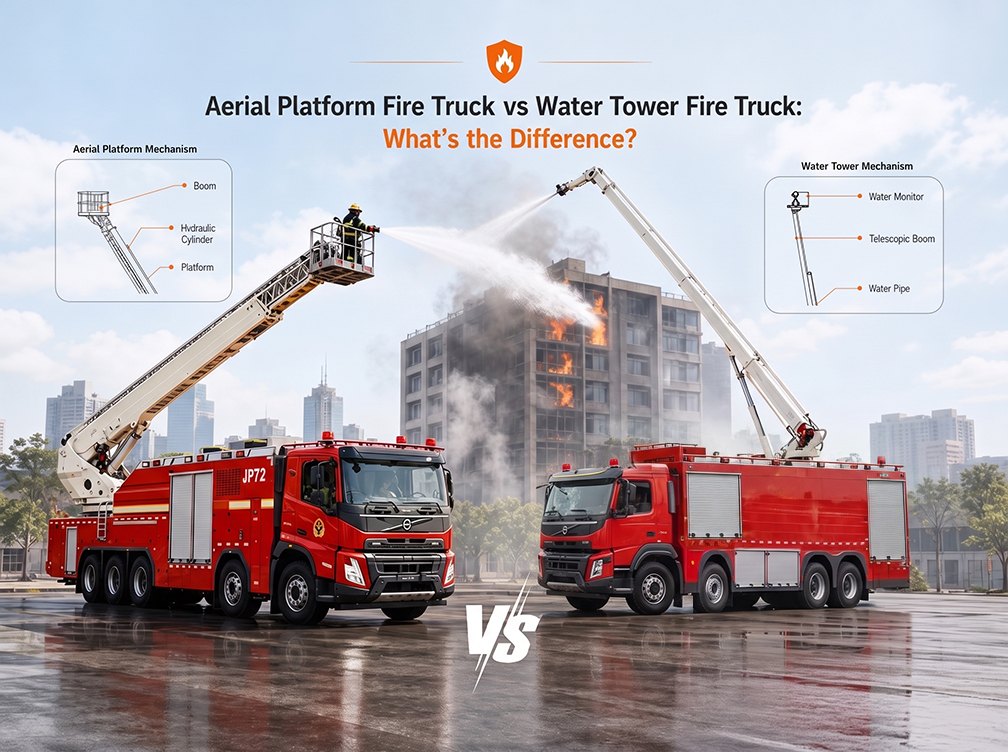
Dalam hal memadamkan kebakaran di gedung bertingkat tinggi, fasilitas industri, atau gudang besar, truk pemadam kebakaran udara sangat penting. Namun, di antara berbagai jenis kendaraan pemadam kebakaran udara, ada dua yang sering membingungkan: truk pemadam kebakaran platform udara dan truk pemadam kebakaran menara air. Meskipun sekilas tampak serupa—keduanya memiliki boom hidraulik dan dirancang untuk pemadaman kebakaran di ketinggian—keduanya menjalankan misi yang pada dasarnya berbeda. Artikel ini menguraikan perbedaan utama antara kedua jenis kendaraan ini, membantu para profesional layanan pemadam kebakaran, manajer pengadaan, dan distributor peralatan membuat keputusan berdasarkan kebutuhan operasional. I. Apa Itu Truk Platform Udara? Menurut standar nasional Tiongkok GB 7956.12-2015, kedua kendaraan ini termasuk dalam kategori kendaraan pemadam kebakaran udara—kendaraan yang dilengkapi boom pengangkat, meja putar, dan peralatan pemadam kebakaran untuk operasi di ketinggian. Namun, definisi spesifiknya menunjukkan perbedaan penting. Truk Pemadam Kebakaran Platform Udara Truk pemadam kebakaran platform udara dilengkapi dengan boom kombinasi lipat atau lipat-teleskopik, platform personel, meja putar, dan perangkat pemadam kebakaran.Fitur penentunya adalah platform kerja (keranjang) di ujung boom, tempat petugas pemadam kebakaran dapat berdiri untuk melakukan operasi penyelamatan dan pemadaman kebakaran .Karakteristik utama:• Dilengkapi dengan platform yang dapat membawa personel dan peralatan seberat 750 lbs hingga lebih dari 1.500 lbs• Dirancang untuk penyelamatan dan pemadaman kebakaran—petugas pemadam kebakaran dapat beroperasi langsung dari platform• Platform dapat digunakan dengan perangkat pengendali penurunan, derek hidraulik, atau seluncuran penyelamatan• Jangkauan horizontal yang lebih luas dan rentang kerja yang lebih besar dibandingkan menara air II. Apa Itu Truk Pemadam Kebakaran Menara Air? Truk pemadam kebakaran menara air dilengkapi dengan boom kombinasi lipat atau lipat-teleskopik, meja putar, dan perangkat pemadam kebakaran—tanpa platform personel. Sebagai gantinya, monitor pemadam (meriam air) dipasang di ujung boom, yang dapat dikendalikan dari jarak jauh dari permukaan tanah. Karakteristik utama:• Tidak ada platform personel—petugas pemadam kebakaran beroperasi dari permukaan tanah melalui kendali jarak jauh• Berfokus secara eksklusif pada pemadaman kebakaran di ketinggian, bukan penyelamatan• Menghasilkan aliran air yang sangat tinggi—melebihi 2.000 galon per menitpada banyak model industri• Dirancang untuk perlindungan kebakaran industri di mana kemampuan penyelamatan tidak diperlukan III. Perbandingan Berdampingan Fitur Truk Pemadam Kebakaran Platform Udara Truk Pemadam Kebakaran Menara Air Fungsi Utama Penyelamatan + pemadaman kebakaran Hanya pemadaman kebakaran Peralatan Ujung Lengan Platform kerja (keranjang) untuk personel Monitor pemadam kebakaran (meriam air) Personel di Lengan Ya—petugas pemadam kebakara...
Detail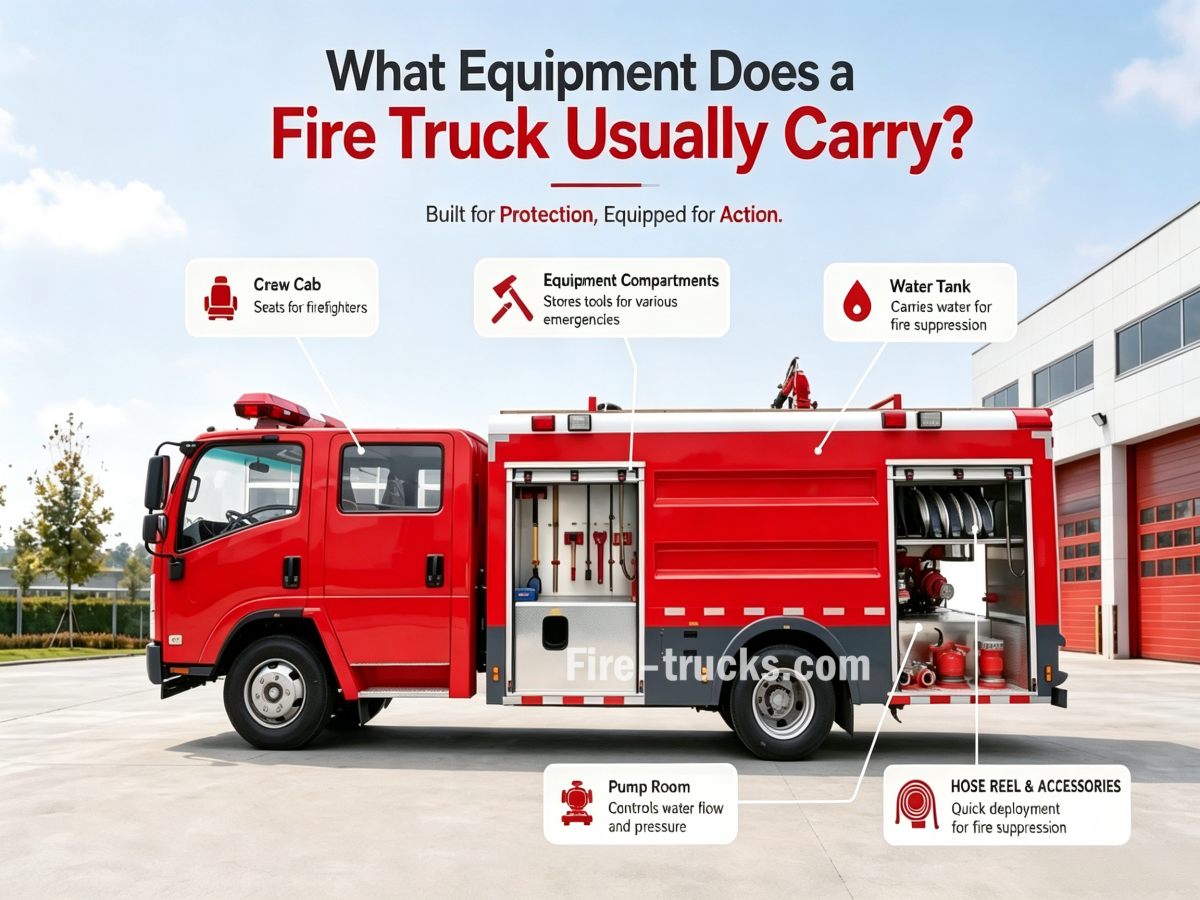
Sebuah truk pemadam kebakaran biasanya membawa peralatan pemadaman kebakaran, pasokan air, penyelamatan, dan perlindungan keselamatan. Peralatan umum mencakup pompa kebakaran, tangki air, selang kebakaran, nosel kebakaran, monitor kebakaran, katup, tangga kebakaran, alat penyelamatan, perlengkapan pelindung, dan perangkat komunikasi. Artikel ini secara sistematis menguraikan klasifikasi, fungsi, dan pertimbangan pemilihan standar peralatan truk pemadam kebakaran , membantu profesional pengadaan dan pengguna akhir membangun pemahaman lengkap tentang konfigurasi kendaraan pemadam kebakaran. I. Klasifikasi Peralatan Truk Pemadam Kebakaran 1. Peralatan Pemadaman Kebakaran— Alat inti untuk pemadaman api secara langsung, termasuk nosel kebakaran, monitor kebakaran, selang kebakaran, pembagi air, dan adaptor. 2. Peralatan Penyelamatan dan Pembobolan Akses— Alat untuk membuat jalur akses bagi operasi penyelamatan dan pemadaman kebakaran, termasuk alat penyelamatan hidraulik, kapak kebakaran, batang congkel, linggis, gergaji potong, dan gergaji mesin. 3. Peralatan Penyelamatan dan Penyedia Kehidupan— Peralatan untuk pencarian, pemindahan, dan perlindungan personel, termasuk tandu, tali penyelamatan, kait pengaman, perangkat pengendali penurunan, alat bantu pernapasan mandiri (SCBA), dan tabung udara cadangan. 4. Peralatan Pembuangan Asap dan Penerangan— Peralatan untuk meningkatkan kondisi lokasi kebakaran, termasuk alat penghisap asap, menara penerangan bergerak, dan lampu sorot pencarian intensitas tinggi portabel. 5. Alat Pelindung Diri (APD)— Perlengkapan untuk melindungi keselamatan petugas pemadam kebakaran, termasuk helm, pakaian pelindung pemadam kebakaran struktural, sarung tangan, sepatu bot, dan sabuk pengaman. 6. Peralatan Komunikasi dan Pengintaian— Peralatan untuk pengumpulan informasi di lokasi kebakaran dan koordinasi komando, termasuk radio dua arah, kamera pencitraan termal, dan detektor gas beracun. II. Peralatan Pemadaman Kebakaran pada Truk Pemadam Kebakaran 1. Pompa Kebakaran Pompa kebakaran adalah sumber tenaga untuk semua operasi pemadaman kebakaran. Pompa ini secara mekanis memberi tekanan pada air, memberikan energi kinetik yang cukup untuk menyelesaikan seluruh proses "penyedotan → pemberian tekanan → pengaliran → pembuangan." Spesifikasi umum pompa kebakaran: • Pompa Kebakaran Tekanan Standar (tipe CB10/30):Laju aliran ≥30L/dtk, tekanan nominal 1,0MPa, pemasangan di bagian belakang. Cocok untuk kendaraan tangki air standar dan truk pemadam kebakaran busa, memenuhi sebagian besar kebutuhan pasokan air pemadaman kebakaran di perkotaan dan industri. • Pompa Kebakaran Tekanan Menengah/Tinggi:Aliran tekanan rendah 30L/dtk pada 1,0MPa, aliran tekanan tinggi 20L/dtk pada 2,0MPa, pemasangan di bagian belakang. Desain tekanan ganda mendukung pasokan volume besar (tekanan rendah) dan pengaliran jarak jauh/ketinggian tinggi (tekanan tinggi) dalam satu pompa. Ideal untuk truk pemadam kebakaran utama perkotaan dan skenario pemadaman kebakar...
Detail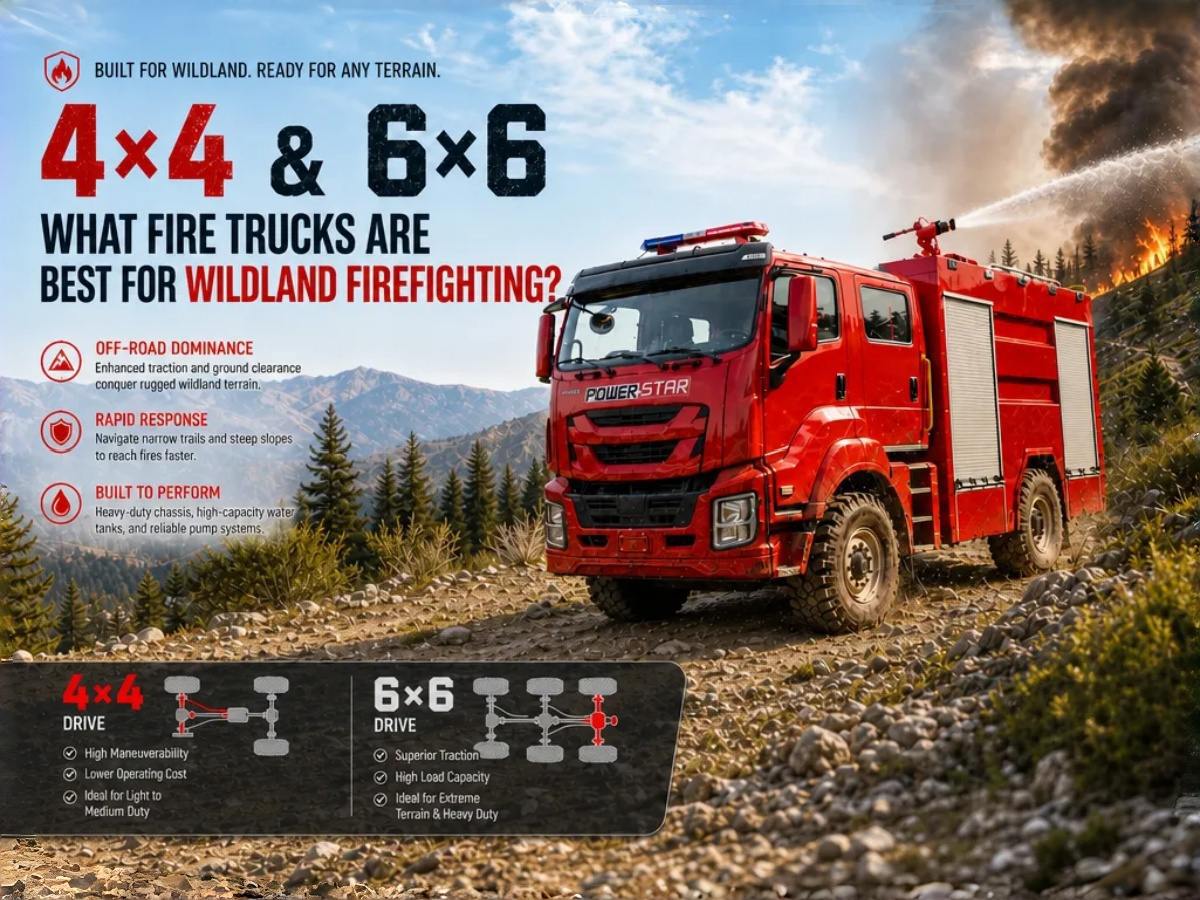
Pemadaman kebakaran hutan menghadirkan tantangan yang secara mendasar berbeda dari pemadaman kebakaran bangunan. Di hutan terpencil, padang rumput, dan medan pegunungan, truk pemadam kebakaran harus melewati jalur sempit, menaiki lereng curam, dan beroperasi jauh dari hidran atau sumber air. Memilih truk pemadam kebakaran yang tepat merupakan keputusan strategis yang secara langsung berdampak pada waktu respons, keselamatan kru, dan efektivitas penanggulangan kebakaran. Artikel ini memberikan ulasan komprehensif mengenai jenis truk pemadam kebakaran yang paling sesuai untuk pemadaman kebakaran hutan, fitur utamanya, dan metode pemilihan, sehingga membantu Anda membuat keputusan yang tepat berdasarkan kebutuhan operasional spesifik Anda. Jawaban Singkat Kebakaran hutan ditandai dengan area kebakaran yang luas, medan yang kompleks, sumber air yang terbatas, dan kondisi jalan yang buruk, sehingga tidak ada satu jenis truk pemadam kebakaran yang dapat menangani semua skenario kebakaran hutan. Secara umum, pemadaman kebakaran hutan terutama menggunakan jenis truk pemadam kebakaran berikut: • Truk pemadam kebakaran hutan ringan: untuk akses jalan hutan dan respons cepat• Truk pemadam kebakaran hutan off-road 4×4: untuk medan pegunungan dan perbukitan• Truk pemadam kebakaran hutan 6×6: untuk kebakaran hutan berskala besar dan operasi berkepanjangan• Truk tangki air: untuk pasokan air berkelanjutan dan dukungan• Truk pemadam kebakaran busa: untuk fasilitas minyak, peralatan hutan, atau kebakaran khusus• Kendaraan penyelamat: untuk komunikasi, penerangan, pembukaan akses, dan dukungan logistik I. Mengapa Kebakaran Hutan Memerlukan Truk Pemadam Kebakaran Khusus? Kebakaran hutan berbeda secara mendasar dari kebakaran bangunan dalam beberapa aspek penting: Karakteristik utama kebakaran hutan:• Area kebakaran luas yang mencakup hektare lahan• Arah angin yang berubah dengan cepat• Medan yang kompleks dan berat• Akses terbatas atau tidak ada akses ke hidran maupun sumber air• Jalan hutan yang sempit dan tidak beraspal• Kondisi komunikasi yang sulit Truk pemadam kebakaran perkotaan standar umumnya tidak cocok untuk pemadaman kebakaran hutan karena alasan berikut: •Tidak memiliki penggerak 4×4 atau penggerak semua roda untuk jalan pegunungan yang tidak beraspal dan lereng curam;•Ukuran yang lebih besar dan jarak bebas tanah yang rendah membuatnya mudah terjebak di jalur hutan sempit dan medan lunak;•Pompa perkotaan mengutamakan aliran tinggi pada tekanan sedang, sedangkan operasi pemadaman hutan memerlukan tekanan tinggi melalui bentangan selang panjang dengan air terbatas—pendekatan yang secara mendasar berbeda. II. Jenis Umum Truk Pemadam Kebakaran Hutan Jenis Truk Pemadam Kebakaran Karakteristik Utama Skenario yang Dapat Diterapkan Truk Pemadam Kebakaran Hutan Ringan Mobilitas tinggi, ukuran ringkas Patroli hutan, serangan awal Truk Pemadam Kebakaran Hutan 4x4 Kemampuan off-road yang kuat Medan pegunungan dan perbukitan Truk Pemadam Kebakaran Hutan 6x6 Kapas...
Detail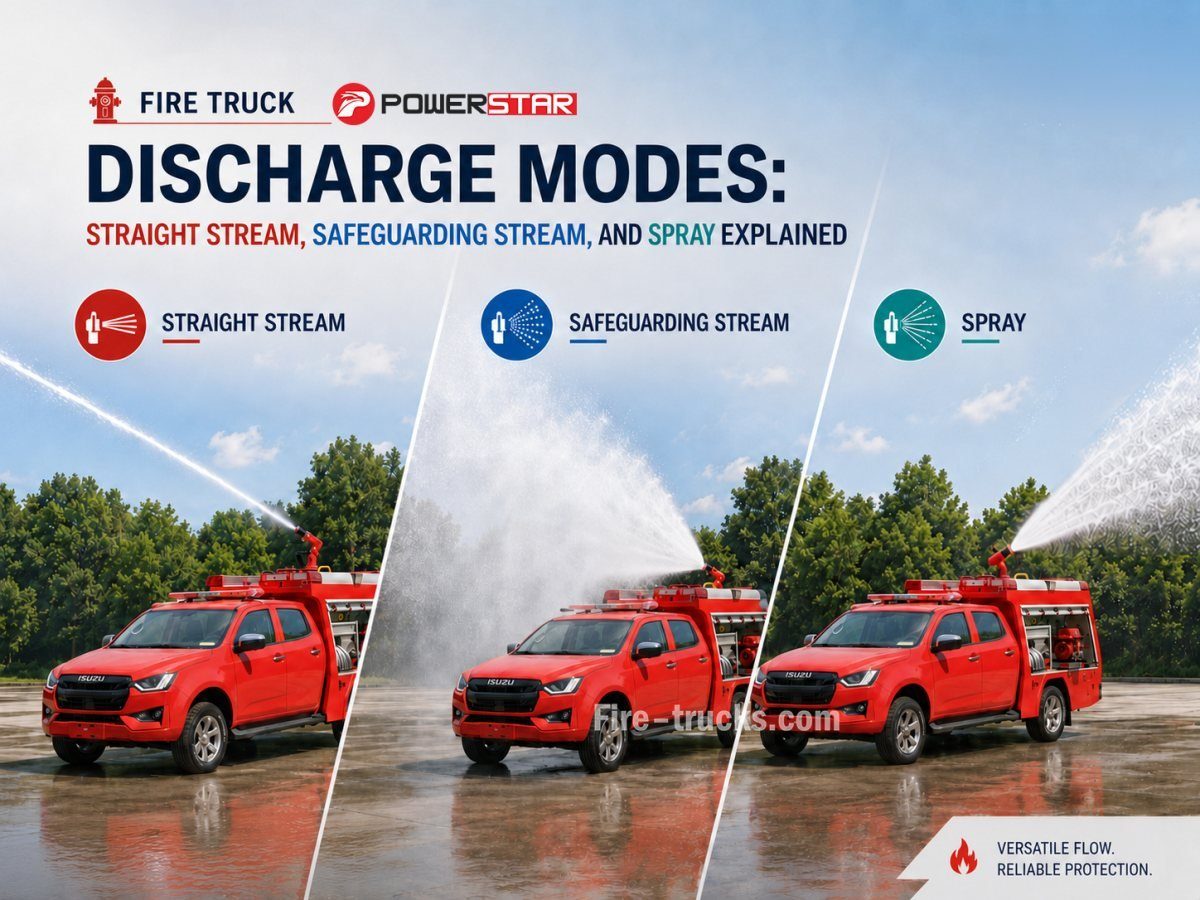
Dalam operasi pemadaman kebakaran, pemilihan mode pancaran secara langsung menentukan efisiensi pemadaman api, keselamatan operasional, dan efektivitas pengendalian kebakaran. Kebanyakan orang tidak menyadari bahwa truk pemadam kebakaran nozel dapat beralih di antara tiga mode pancaran utama: pancaran lurus, pancaran semprot, dan pancaran perlindungan. Mode yang berbeda memiliki variasi signifikan dalam pola aliran, jangkauan, gaya benturan, dan area cakupan, serta masing-masing sesuai dengan skenario kebakaran yang sepenuhnya berbeda. Artikel ini, berdasarkan standar operasi pemadaman kebakaran profesional, menganalisis secara menyeluruh prinsip, karakteristik utama, dan skenario penerapan dari tiga mode pancaran, membantu pelanggan kami menguasai teknik pancaran truk pemadam kebakaran secara sistematis. I. Mengapa Truk Pemadam Kebakaran Membutuhkan Mode Pancaran yang Berbeda? Pancaran lurus, pancaran semprot, dan pancaran perlindungan masing-masing berhubungan dengan tiga mekanisme pemadaman api yang berbeda: pemadaman melalui benturan, pencekikan melalui penguapan, dan perlindungan dari radiasi panas. Petugas pemadam kebakaran harus beralih secara fleksibel sesuai kondisi lokasi. Jadi, mengapa kita tidak bisa terus menggunakan hanya satu jenis pancaran? 1. Keberagaman jenis kebakaran membutuhkan bentuk media pemadam yang berbeda Jenis kebakaran yang berbeda memiliki karakteristik pembakaran yang berbeda, yang menentukan metode pemadaman yang sesuai: • Kebakaran material padat Kelas A memerlukan benturan pancaran lurus untuk memecah material yang terbakar dan menembusnya untuk pendinginan internal; • Kebakaran cairan Kelas B tidak dapat menggunakan benturan pancaran lurus (yang menyebabkan percikan dan memperluas kebakaran), tetapi harus menggunakan pancaran perlindungan atau pancaran semprot untuk penutupan dan pengenceran; • Kebakaran listrik bertegangan Kelas E hanya dapat menggunakan pancaran semprot, karena tetesan air halus tidak membentuk jalur penghantar listrik yang kontinu; • Kebakaran ruang tertutup memerlukan pancaran semprot untuk memenuhi seluruh ruang, mencapai pemadaman melalui penyerapan panas penguapan dan pencekikan. Tidak ada satu mode pun yang dapat menyesuaikan diri dengan semua jenis kebakaran. 2. Tahapan berbeda dari kebakaran yang sama membutuhkan pendekatan taktis yang berbeda Bahkan untuk kebakaran yang sama, tahapan yang berbeda memerlukan mode pancaran yang berbeda: • Pada tahap awal ketika api sangat kuat, pancaran lurus diperlukan untuk memberikan benturan jarak jauh pada titik api guna penekanan cepat; • Selama proses maju, pancaran perlindungan diperlukan untuk membentuk penghalang tirai air yang menghalangi radiasi panas dan melindungi personel; • Sebelum memasuki ruangan, pancaran semprot diperlukan untuk mendinginkan dan mengencerkan asap serta gas, menciptakan kondisi untuk serangan dari dalam. Satu mode saja tidak dapat mencakup kebutuhan operasional selama seluruh proses pemadaman kebakaran. 3. Jangkauan, ...
Detail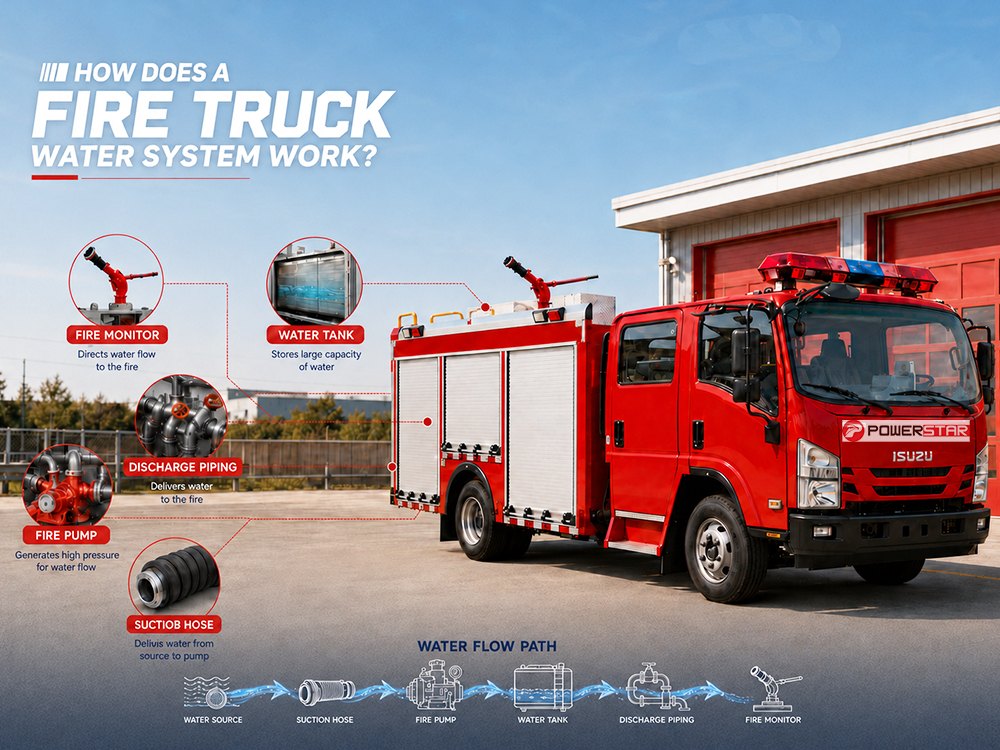
Sistem perpipaan air truk pemadam kebakaran adalah inti dari setiap operasi pemadaman kebakaran. Sistem ini secara presisi mengarahkan air dari tangki atau sumber eksternal melalui pompa, katup, dan pipa untuk mengalirkan air bertekanan tinggi atau busa ke lokasi kebakaran — baik itu kebakaran gedung tinggi di pusat kota yang padat maupun kebakaran tangki penyimpanan petrokimia di zona industri. truk pemadam kebakaran sistem perpipaan air terdiri dari beberapa komponen yang bekerja bersama: pompa pemadam kebakaran, tangki air, selang hisap, pipa pembuangan, katup, sambungan pembagi, sambungan pengumpul, saringan, monitor pemadam kebakaran, kopling selang, dan lainnya. Jalur aliran lengkap adalah: Tangki Air → Selang Hisap → Saringan → Pompa Pemadam Kebakaran → Sistem Pengaturan Tekanan → Manifold Pembuangan → Katup → Sambungan Pembagi → Monitor Pemadam Kebakaran / Kopling Selang → Nosel Artikel ini menjelaskan setiap komponen sistem perpipaan air dan bagaimana komponen tersebut bekerja bersama untuk mengalirkan air dengan tekanan dan aliran yang tepat. I. Komponen Inti Sistem Perpipaan Air Tangki Air Menyimpan pasokan air di dalam kendaraan. ● Kapasitas: Biasanya 2.000–12.000 liter. ● Penyaluran: Menyuplai pompa melalui pipa masuk. ● Fitur: Sekat anti-guncangan air untuk stabilitas kendaraan, saringan untuk menyaring kotoran, dan sistem pengisian awal untuk mengambil air dari sumber air alami. Pompa Pemadam Kebakaran Pompa sentrifugal yang digerakkan oleh mesin truk melalui PTO; satu tahap/multi tahap, berbahan besi cor atau perunggu. ● Kelas tekanan: Tersedia dalam peringkat standar 0,8 MPa, 1,0 MPa, 1,2 MPa, dan 1,4 MPa, sesuai dengan kebutuhan pemadaman kebakaran umum. ● Laju aliran: Berkisar dari 1.200 hingga 6.000 L/menit, dengan kurva kinerja yang dioptimalkan untuk operasi bertekanan tinggi maupun bervolume besar. Katup dan Perpipaan Jaringan pipa dan katup yang mengendalikan arah dan volume aliran air. ● Katup masuk: Menghubungkan pompa ke sumber air eksternal (hidran atau titik pengambilan air) ● Katup tangki-ke-pompa: Memungkinkan pompa mengambil air langsung dari tangki yang tersedia di kendaraan ● Katup pembuangan: Mengendalikan aliran air ke selang dan nosel II. Cara Kerja Sistem Perpipaan Air Truk Pemadam Kebakaran Langkah 1: Pengambilan Air dan Pengisian Awal Air masuk ke dalam sistem dari tangki yang tersedia di kendaraan, hidran pemadam kebakaran, atau sumber air alami (danau, sungai, kolam). Saat mengambil air dari sumber alami, sistem pengisian awal (pompa vakum) mengeluarkan udara dari selang hisap, menciptakan ruang hampa yang memungkinkan tekanan atmosfer mendorong air masuk ke pompa. Saringan menyaring kotoran untuk melindungi pompa, dan katup satu arah mencegah aliran balik. Langkah 2: Beri Tekanan pada Pompa Pompa sentrifugal digerakkan oleh mesin truk melalui power take-off (PTO). Setelah air mengisi pompa, impeler berputar pada kecepatan tinggi (1.500–2.500 RPM). Gaya sentrifugal melemparkan air ke arah luar, meningkat...
Detail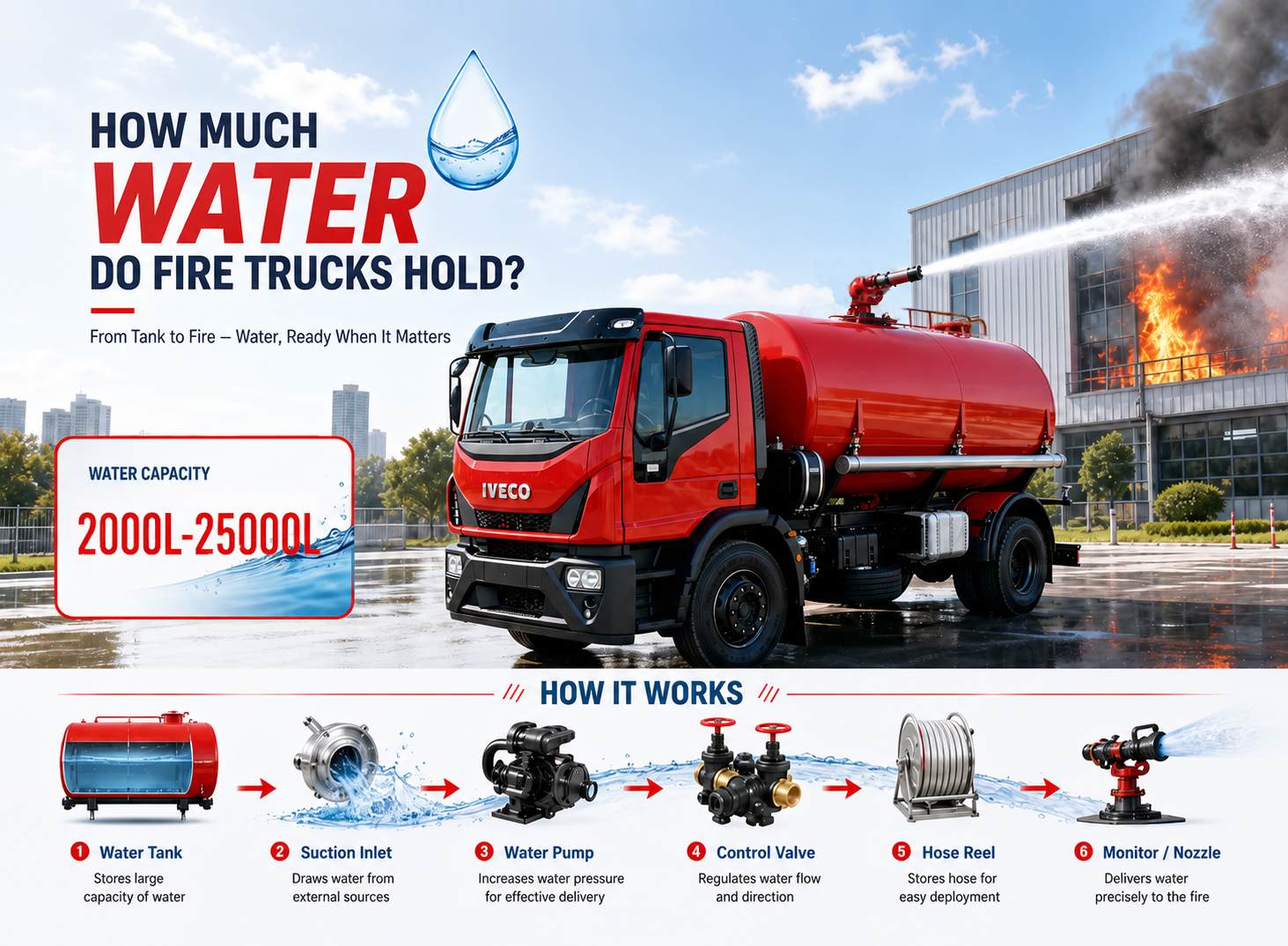
Berapa banyak air yang dapat dibawa oleh mobil pemadam kebakaran? Ini adalah salah satu pertanyaan pertama yang dihadapi pelanggan kami saat memilih mobil pemadam kebakaran. Tidak ada angka tetap tunggal — hal ini bergantung pada jenis kendaraan, kapasitas sasis, tujuan desain, dan peraturan regional, mulai dari unit tugas ringan berkapasitas 2.000 liter hingga mobil pemadam kebakaran industri berkapasitas 25.000 liter. Namun, tangki yang lebih besar tidak selalu berarti kinerja yang lebih baik;kendaraan pemadam kebakaran kapasitas tangki air harus disesuaikan dengan tepat dengan laju aliran pompa, laju pelepasan monitor, dan kapasitas sasis untuk memberikan hasil pemadaman kebakaran yang efektif. Artikel ini dimulai dengan dasar-dasar kapasitas tangki air mobil pemadam kebakaran, menganalisis rentang penyimpanan umum untuk berbagai jenis kendaraan, mengkaji faktor-faktor utama yang memengaruhi desain tangki, dan memberikan panduan pembelian yang praktis. Poin Utama: Kapasitas tangki air mobil pemadam kebakaran biasanya berkisar antara 2.000 hingga 25.000 liter Berbagai jenis mobil pemadam kebakaran memiliki kapasitas tangki yang berbeda Tangki yang lebih besar tidak berarti kemampuan pemadaman kebakaran yang lebih baik Kapasitas tangki harus disesuaikan dengan aliran pompa, aliran monitor, dan kapasitas sasis Pemadaman kebakaran industri biasanya memerlukan tangki besar, sedangkan pemadaman kebakaran kota memprioritaskan kemampuan manuver » I. Tiga Jenis Dasar Tangki Air Mobil Pemadam Kebakaran Mobil Pompa:Ini adalah mobil pemadam kebakaran kota yang paling umum. Kendaraan ini terutama mengandalkan hidran kebakaran untuk pasokan air dan membawa sekitar 1.900–3.800 liter air di dalam kendaraan untuk serangan awal. Inti dari kendaraan ini adalah pompa, bukan tangki — kendaraan ini dirancang untuk mengalirkan air bertekanan setelah terhubung ke hidran. Mobil Tangki (Pengangkut Air):Kendaraan ini didedikasikan untuk mengangkut air dalam jumlah besar, dengan kapasitas tangki biasanya melebihi 11.400 liter. Kendaraan ini memainkan peran penting di daerah pedesaan dan terpencil yang tidak memiliki hidran kebakaran, dengan mengangkut air dari sumber air ke lokasi kebakaran untuk digunakan oleh mobil pompa. Mobil Pompa-Tangki:Kendaraan ini menggabungkan fungsi pemompaan dan pengangkutan air dalam satu unit. Kendaraan ini dapat mengalirkan air untuk pemadaman kebakaran sekaligus memasok kendaraan lain. Kapasitas tangki biasanya berkisar antara 5.700 hingga 11.400 liter, menjadikannya solusi serbaguna bagi departemen pemadam kebakaran. » II. Berapa Banyak Air yang Dapat Dibawa Berbagai Jenis Mobil Pemadam Kebakaran? Jenis Mobil Pemadam Kebakaran Kapasitas Tangki Umum Aplikasi Utama Mobil pemadam kebakaran tugas ringan 2.000–3.000 L Respons cepat perkotaan, serangan awal Mobil pompa kota 3.000–6.000 L Pemadaman kebakaran kota, kebakaran struktur Mobil pompa tugas menengah 6.000–10.000 L Tugas gabungan perkotaan dan industri Mobil pompa tugas berat 10.000–15...
Detail
Silakan baca terus, tetap ikuti perkembangannya, berlangganan, dan kami menyambut baik pendapat Anda.

 Jaringan IPv6 didukung

 Indonesia
  English
 français
 Deutsch
 русский
 italiano
 español
 português
 Nederlands
 العربية
 日本語
日本語 한국의
한국의 Türkçe
 Melayu
 ไทย
ไทย Tiếng Việt
 中文
中文 қазақ
қазақ Filipino
 မြန်မာ
 српски