Tinggalkan Pesan
Jika Anda tertarik dengan produk kami dan ingin mengetahui detail lebih lanjut, silakan tinggalkan pesan di sini, kami akan membalas Anda sesegera mungkin.

Bagaimana Cara Kerja PTO (Pengambil Daya) pada Mobil Pemadam Kebakaran?
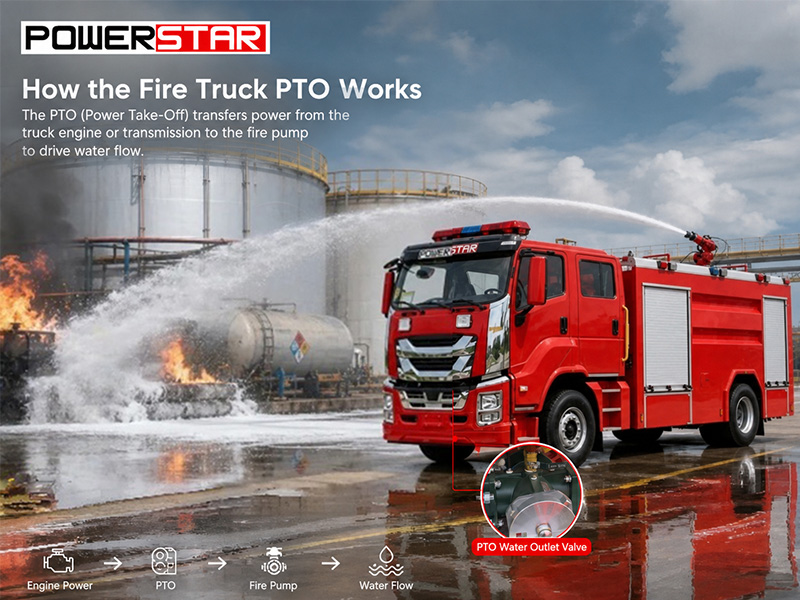
PTO (Power Take-Off) pada truk pemadam kebakaran adalah perangkat transmisi daya yang mentransfer tenaga mesin ke pompa pemadam kebakaran. Ketika petugas pemadam kebakaran mengaktifkan PTO, tenaga mekanis dari mesin disalurkan melalui transmisi dan PTO ke pompa pemadam kebakaran — ini adalah prinsip kerja inti dari cara sebuah truk pemadam kebakaran sistem PTO beroperasi — memungkinkan pompa menghasilkan air atau busa bertekanan tinggi dengan aliran besar tanpa memerlukan mesin tambahan terpisah.
Truk pemadam kebakaran modern biasanya menggunakan sistem PTO yang dipasang di samping atau sistem PTO daya penuh. Sistem ini menawarkan keluaran daya yang stabil, pengoperasian yang mudah, dan biaya perawatan yang rendah, sehingga menjadi komponen penting dalam sistem pemadaman kebakaran truk pemadam kebakaran.
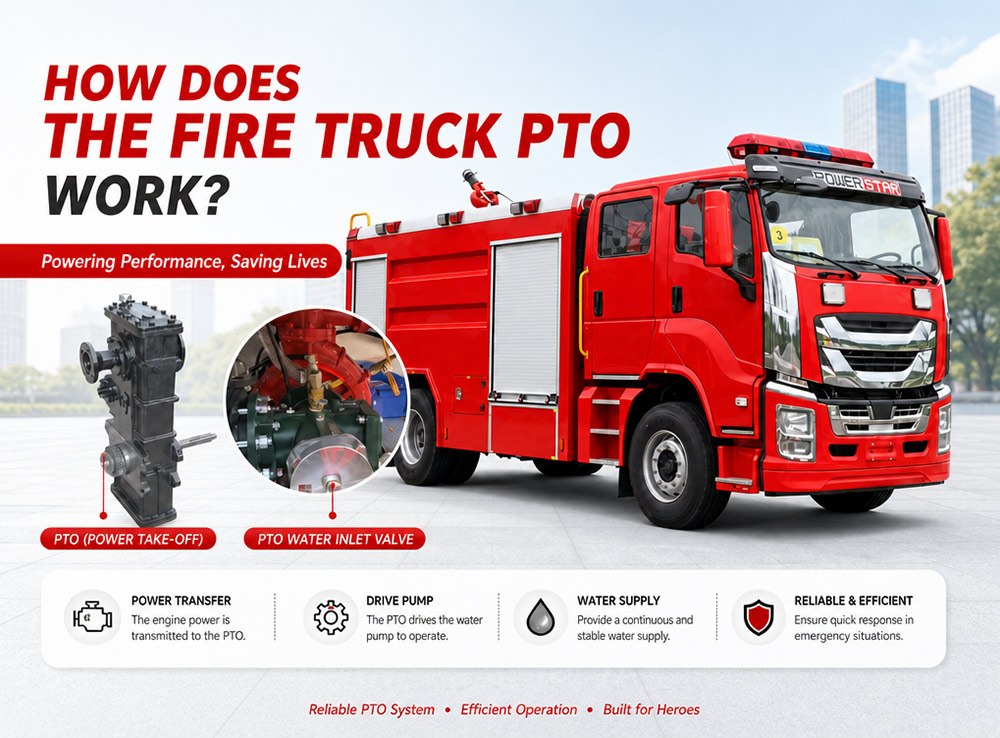
PTO (Power Take-Off) adalah komponen penting dalam sistem daya truk pemadam kebakaran. Ini adalah perangkat transmisi roda gigi yang dipasang di antara mesin dan transmisi, yang dirancang untuk "mengalihkan" sebagian tenaga mekanis dari mesin atau transmisi kendaraan ke pompa pemadam kebakaran atau peralatan tambahan lainnya, tanpa memengaruhi kemampuan berkendara normal kendaraan.
Mesin truk pemadam kebakaran pada awalnya hanya bertugas menggerakkan roda. Namun, setelah truk pemadam kebakaran tiba di lokasi kebakaran, roda tidak lagi memerlukan tenaga, sementara pompa pemadam kebakaran membutuhkan tenaga untuk menyedot dan memberi tekanan pada air. PTO adalah perangkat yang menjalankan "peralihan daya" ini.
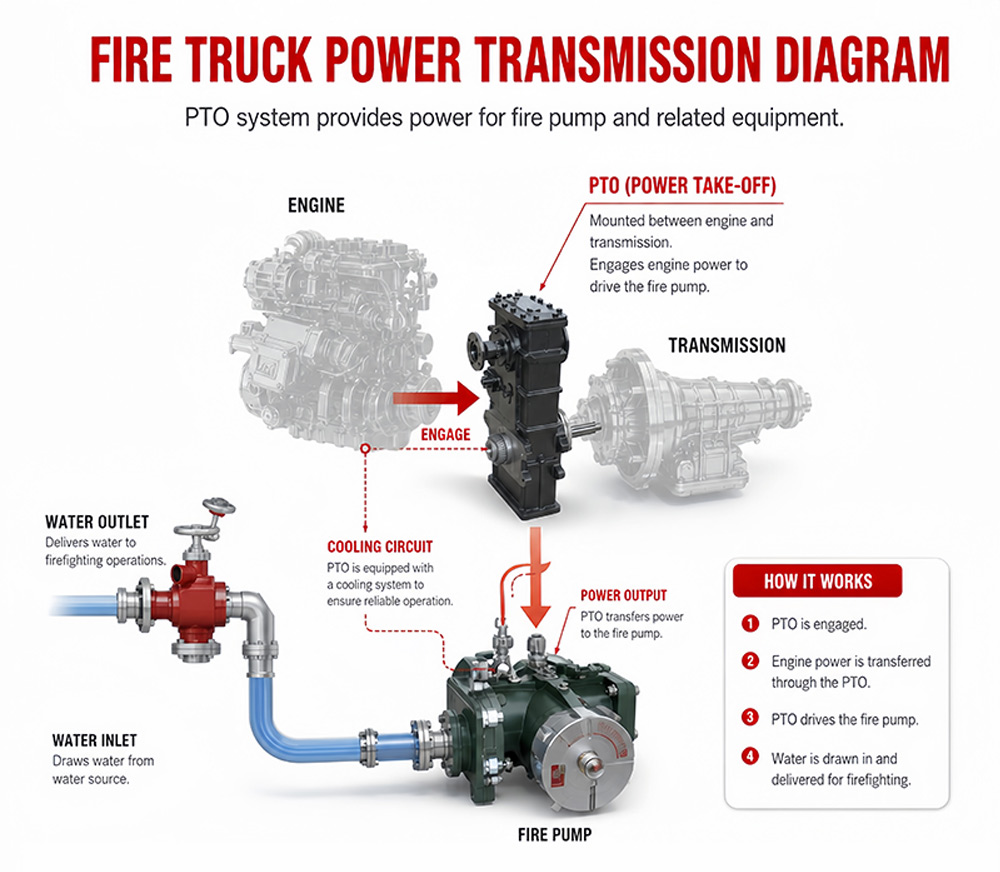
Power Take-Off (PTO) secara harfiah berarti "perangkat keluaran daya".
Pada truk pemadam kebakaran, istilah ini mengacu pada pengambilan tenaga putar dari roda gila mesin atau roda gigi transmisi melalui penghubungan roda gigi, lalu menyalurkannya ke pompa pemadam kebakaran atau peralatan tambahan lainnya.
Namanya menggambarkan fungsinya:
Mesin = Sumber daya
PTO = Penyalur daya
Pompa pemadam kebakaran = Bagian pengguna daya
Oleh karena itu, PTO adalah jembatan yang menghubungkan "sumber daya" dan "sistem pemadaman kebakaran".
Alasan utama truk pemadam kebakaran harus dilengkapi dengan PTO adalah karena operasi pemadaman kebakaran memerlukan keluaran daya tinggi yang terus-menerus dan stabil, yang tidak dapat bergantung pada kondisi kendaraan saat berkendara.
Alasan utama:
1. Menyediakan daya pemadaman kebakaran secara terus-menerus
Pompa pemadam kebakaran perlu beroperasi dalam jangka waktu lama selama operasi pemadaman. PTO memungkinkan mesin terus menggerakkan pompa pemadam kebakaran pada putaran idle atau RPM tetap, memastikan tekanan dan aliran air yang stabil.
2. Meningkatkan efisiensi penggunaan daya
Tanpa PTO, diperlukan mesin tambahan terpisah untuk menggerakkan pompa pemadam kebakaran, yang akan meningkatkan:
Biaya
Kompleksitas perawatan
Risiko kegagalan
Penggunaan ruang
PTO secara langsung memanfaatkan tenaga mesin kendaraan, sehingga meningkatkan efisiensi keseluruhan.
3. Mendukung berbagai sistem pemadaman kebakaran
Truk pemadam kebakaran industri modern mungkin tidak hanya dilengkapi dengan pompa air tetapi juga:
Sistem busa
Sistem bubuk kering
Sistem air bertekanan tinggi
Monitor pemadam kebakaran yang dikendalikan jarak jauh
Tanpa PTO, hanya ada dua solusi:
Memasang mesin terpisah untuk menggerakkan pompa → meningkatkan berat, biaya, titik perawatan, dan membutuhkan ruang
Jaga pompa tetap terhubung secara permanen ke transmisi → pompa berhenti saat kendaraan berhenti, tidak dapat memompa air di lokasi
PTO menyelesaikan kedua masalah sekaligus:
| Mode | Status PTO | Tujuan Daya | Hasil |
| Mode berkendara | Tidak terhubung | Semua ke roda | Berkendara normal |
| Mode pemadaman kebakaran | Terhubung | Semua ke pompa pemadam kebakaran | Memompa saat diam |
PTO pada dasarnya adalah "sistem distribusi dan konversi daya" yang mengubah tenaga penggerak kendaraan menjadi tenaga operasional pemadaman kebakaran.
Dari sudut pandang teknik, jalur daya lengkapnya adalah:
Mesin → Transmisi → PTO → Poros Penggerak → Pompa Pemadam Kebakaran → Monitor Api/Sistem Selang
Prinsip kerja PTO dapat diringkas menjadi tiga tahap utama: pengambilan daya, penghubungan, dan transmisi.
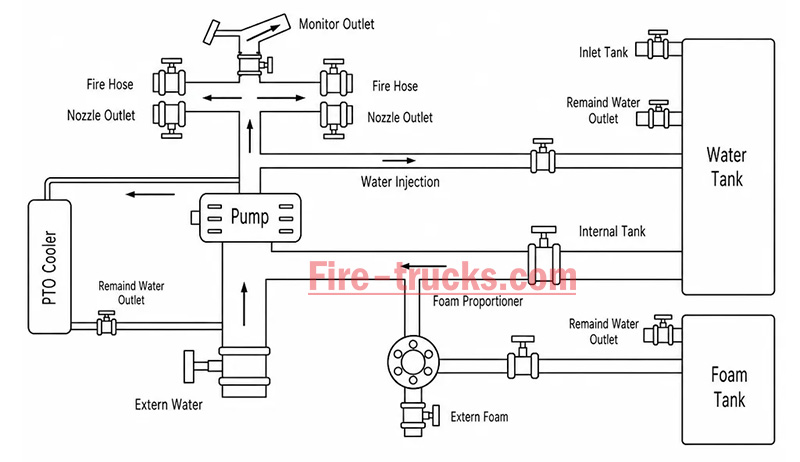
PTO mengambil daya dari mesin. Tergantung pada posisi pemasangan, metode pengambilan daya berbeda:
| Jenis PTO | Posisi Pemasangan | Sumber Daya | Karakteristik |
| PTO yang dipasang di samping | Sisi transmisi | Roda gigi poros lawan transmisi | Struktur sederhana, daya lebih rendah (≤50% daya mesin) |
| PTO sandwich | Di antara mesin dan transmisi | Roda gila mesin | Keluaran daya penuh, konfigurasi utama |
| PTO poros terbagi | Di antara transmisi dan poros penggerak | Poros keluaran transmisi | Daya tinggi, memungkinkan pemompaan saat berkendara |
Setelah pengemudi menekan sakelar PTO di kabin, mekanisme pengaktifan mulai bekerja:
| Metode Pengaktifan | Prinsip Kerja | Umum Digunakan |
| Kontrol solenoid listrik | Sinyal listrik mengaktifkan solenoid, mendorong garpu pemindah | Umum digunakan pada truk pemadam kebakaran modern |
| Kontrol pneumatik | Udara bertekanan mendorong piston, menggerakkan garpu | Truk pemadam kebakaran besar |
| Kabel manual | Kabel mekanis langsung menarik garpu | Kendaraan yang lebih tua |
Urutan pengoperasian:
Tekan sakelar PTO → Solenoid/silinder bekerja → Garpu pemindah mendorong roda gigi geser → Berkaitan dengan roda gila atau roda gigi transmisi → Daya tersambung
Setelah poros keluaran PTO mulai berputar, daya disalurkan melalui poros penggerak ke pompa pemadam kebakaran:
Poros keluaran PTO berputar → Poros penggerak → Poros masukan pompa pemadam kebakaran → Impeler pompa berputar → Air diberi tekanan dan dikeluarkan
| Langkah | Tindakan | Hasil |
|---|---|---|
| Langkah 1 | Mesin menyala, kendaraan dalam keadaan diam atau melaju | Mesin berjalan, PTO tidak aktif |
| Langkah 2 | Tiba di lokasi kejadian, pengemudi menekan sakelar PTO | Daya penggerak dinonaktifkan (pada beberapa model), roda gigi PTO diaktifkan |
| Langkah 3 | PTO membentuk sambungan daya dengan transmisi | Daya transmisi dialihkan ke poros keluaran PTO |
| Langkah 4 | Poros penggerak menyalurkan daya ke pompa pemadam kebakaran | Pompa pemadam kebakaran mulai menerima daya mekanis secara terus-menerus |
| Langkah 5 | Impeler pompa pemadam kebakaran berputar dengan kecepatan tinggi | Penyedotan → Pemberian tekanan → Pengiriman ke jalur keluaran → Pemadaman kebakaran |
| Langkah 6 | Sistem mencapai RPM yang seimbang | Keluaran stabil, tekanan, aliran, dan pola semprotan dapat disesuaikan |
Sistem PTO truk pemadam kebakaran adalah rantai transmisi daya lengkap, dengan beberapa komponen yang bekerja bersama untuk menyalurkan daya mesin ke pompa pemadam kebakaran. Sistem ini dapat diuraikan menjadi enam komponen inti:
Mesin adalah sumber daya sistem PTO dan jantung dari seluruh truk pemadam kebakaran.
Fungsi: Menghasilkan daya putar mentah, menggerakkan roda gila atau poros engkol.
Keluaran daya: Biasanya 300–600 HP (tergantung model sasis dan konfigurasi).
Hubungan dengan PTO: PTO mengambil daya dari roda gila atau poros engkol mesin — ini adalah titik awal daya.
Karakteristik utama: Putaran mesin secara langsung memengaruhi kecepatan keluaran PTO dan kemampuan pembuangan air pompa pemadam kebakaran. Truk pemadam kebakaran biasanya dilengkapi mesin diesel berdaya tinggi, yang tidak hanya menggerakkan kendaraan tetapi juga menyediakan cadangan daya yang cukup untuk pompa pemadam kebakaran. Setelah PTO diaktifkan, operator dapat mengontrol tekanan pembuangan pompa dengan menyesuaikan putaran mesin.
Transmisi bertanggung jawab atas penyaluran daya dan penyesuaian kecepatan.
Fungsi: Menerima daya mesin dan menyesuaikan kecepatan serta torsi melalui berbagai kombinasi roda gigi.
Hubungan dengan PTO: PTO yang dipasang di sisi transmisi mengambil daya dari roda gigi transmisi internal; PTO sandwich dipasang di bagian depan transmisi.
Karakteristik utama: Posisi roda gigi transmisi tidak memengaruhi kecepatan keluaran PTO — PTO beroperasi secara independen dari pemilihan roda gigi.
Dua posisi pengambilan daya:
Pengambilan daya melalui jendela sisi transmisi: PTO dipasang di sisi transmisi, mengambil daya dari roda gigi poros penghitung atau poros perantara; umum digunakan pada truk pemadam kebakaran tugas menengah.
Pengambilan daya ujung belakang transmisi (sandwich): PTO dipasang di antara mesin dan transmisi, mengambil daya langsung dari roda gila, sehingga memungkinkan keluaran daya penuh.
PTO adalah inti dari seluruh sistem, bertanggung jawab untuk "mengambil" daya dari mesin dan menyalurkannya ke pompa pemadam kebakaran.
Fungsi: Mengambil daya dari mesin atau transmisi dan mengubahnya menjadi kecepatan serta torsi yang sesuai untuk pompa pemadam kebakaran.
Posisi pemasangan: Sisi transmisi (dipasang di sisi) atau di antara mesin dan transmisi (sandwich).
Karakteristik utama: Menentukan efisiensi transmisi daya, penyesuaian kecepatan, dan kemudahan pengoperasian.
Poros penggerak adalah "jembatan daya" yang menghubungkan PTO dan pompa pemadam kebakaran.
Fungsi: Menyalurkan daya putar dari poros keluaran PTO ke masukan pompa pemadam kebakaran.
Struktur:Biasanya terdiri dari tabung poros logam, sambungan universal, dan sambungan berspline.
Karakteristik utama:Harus dipasang dengan presisi untuk menghindari getaran; sambungan universal memungkinkan kompensasi sudut.
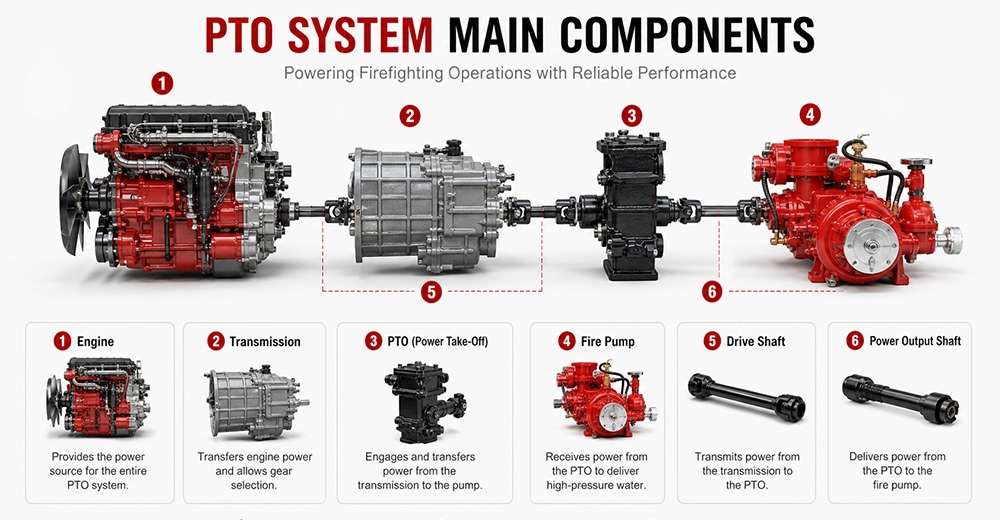
Pompa pemadam kebakaran adalah beban terakhir dari sistem PTO, bertanggung jawab untuk mengubah energi mekanik menjadi energi tekanan air.
Fungsi:Menerima tenaga putar dari PTO, menggerakkan impeller untuk berputar, menghisap air, dan mengeluarkannya dengan tekanan tinggi.
Tipe:Pompa sentrifugal (tahap tunggal, dua tahap, atau multi-tahap).
Debit tipikal:20 L/dtk – 180 L/dtk (1.200 – 6.000 L/menit).
Tekanan tipikal:1,0 – 2,5 MPa (10 – 25 bar).
Sistem kontrol PTO adalah "pusat komando" antara pengemudi dan sistem PTO, bertanggung jawab untuk pengaktifan, pemutusan, perlindungan keselamatan, dan indikasi status.
Fungsi:Mengontrol pengaktifan dan pemutusan PTO, memantau status sistem, dan menyediakan perlindungan keselamatan.
Lokasi operasi:Interior kabin (kontrol utama) dan panel pompa (kontrol tambahan).
Metode kontrol:Kabel manual, solenoid elektrik, pneumatik.
Fungsi kontrol spesifik:
(1) Kontrol Pengaktifan PTO
Operator menekan sakelar PTO (solenoid elektrik/pneumatik) atau menarik tuas (manual) di kabin. Sistem kontrol mengirimkan sinyal untuk menghubungkan gigi internal PTO dengan sumber tenaga. Setelah pengaktifan berhasil dikonfirmasi, lampu indikator menyala, memungkinkan operator meningkatkan RPM mesin.
(2) Kontrol Pemutusan PTO
Operator menekan sakelar lagi atau mengatur ulang tuas. Sistem kontrol memutuskan sinyal, dan gigi PTO terlepas. Setelah pemutusan dikonfirmasi, lampu indikator mati.
| Tipe PTO | Posisi Pemasangan | Sumber Tenaga | Output Tenaga | Aplikasi Tipikal |
| PTO Sandwich | Di antara mesin dan transmisi | Roda gila mesin | Tenaga penuh (≥90%) | Pompa kebakaran, truk udara |
| PTO poros terpisah | Poros penggerak di tengah sasis | Poros keluaran transmisi | Daya penuh | Truk vakum besar, truk pemadam kebakaran bandara |
| PTO yang dipasang di samping | Sisi transmisi | Roda gigi transmisi | Daya sebagian (lebih rendah) | Truk penyiram, truk vakum kecil |
PTO sandwich
Keunggulan:Keluaran daya penuh (≥90%), mendukung "pemompaan saat berkendara" (fungsi ganda), efisiensi transmisi tinggi, pelumasan mudah.
Kekurangan:Biaya lebih tinggi, pemasangan rumit, memerlukan modifikasi pada sambungan mesin-transmisi.
PTO poros terpisah
Keunggulan:Keluaran daya penuh, tidak memerlukan ruang tambahan, keandalan tinggi, keseimbangan dinamis baik, dapat menggantikan mesin tambahan untuk menggerakkan pompa besar.
Kekurangan:Memerlukan pemotongan poros penggerak asli, pemilihan posisi pemasangan harus mempertimbangkan sudut poros penggerak dan kompensasi panjang.
PTO yang dipasang di samping
Keunggulan:Biaya rendah, pemasangan sederhana, dapat mengambil daya langsung dari sisi transmisi.
Kekurangan:Hanya tersedia daya sebagian, torsi keluaran lebih rendah, tidak dapat menggerakkan pompa pemadam kebakaran berdaya tinggi, terutama digunakan untuk peralatan berkecepatan rendah dan berdaya rendah.
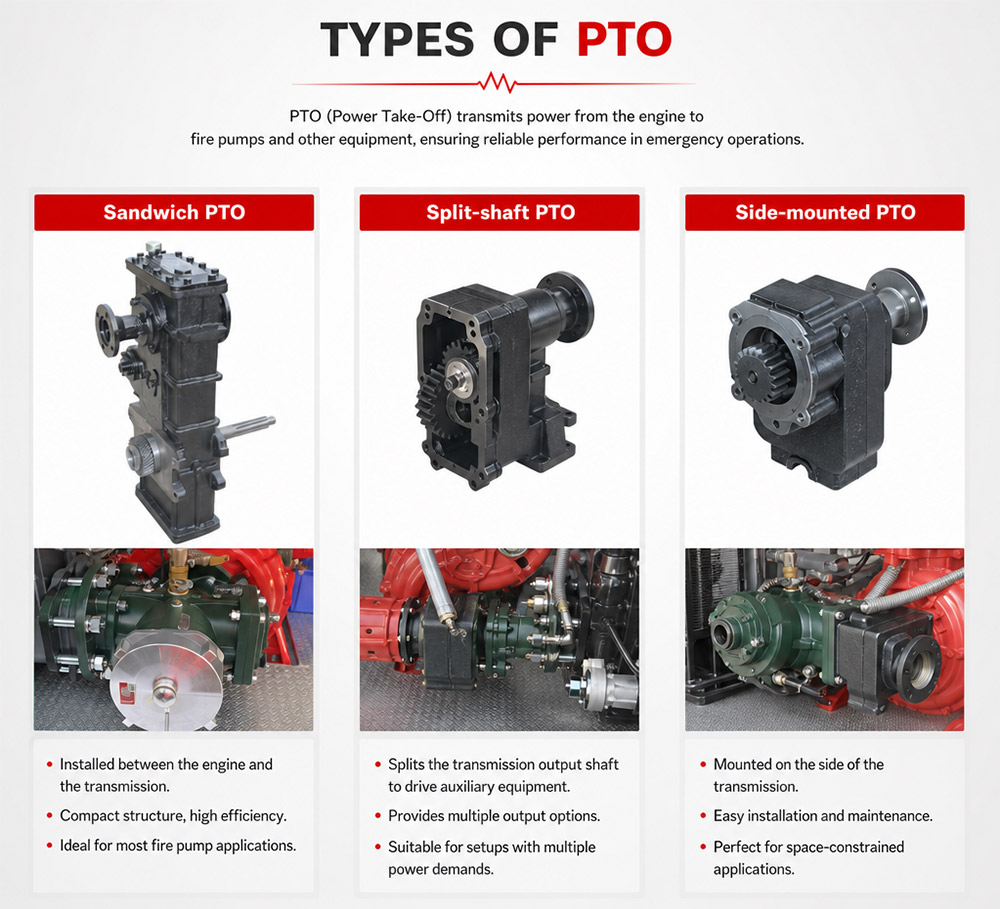
Proses ini mengikuti rantai transmisi mekanis yang jelas:
Mesin → PTO → Poros Penggerak → Pompa Pemadam Kebakaran → Rotasi Impeler → Pengisapan → Pemberian Tekanan → Monitor Pemadam Kebakaran
| Faktor | Peran |
|---|---|
| Karakteristik pompa sentrifugal | Ketika kecepatan impeler konstan, tekanan keluaran tetap stabil secara alami |
| Sambungan kaku PTO | Tidak ada selip atau kehilangan daya, memastikan masukan daya yang stabil dan berkelanjutan |
| Pengatur tekanan | Secara otomatis mendeteksi perubahan aliran dan menyesuaikan RPM mesin untuk mempertahankan tekanan yang ditetapkan |
| Katup pelepas | Secara otomatis melakukan bypass ketika tekanan melebihi batas, mencegah kerusakan peralatan |
① Kecepatan pompa ditentukan oleh RPM mesin
Kecepatan impeler pompa pemadam = RPM Mesin × rasio PTO. Rasio PTO tetap (misalnya, 1,75:1), sehingga kecepatan pompa berubah secara langsung mengikuti RPM mesin.
Rumus perhitungan:
RPM Mesin × rasio PTO = Kecepatan pompa (RPM)
② Hubungan fisik antara tekanan dan kecepatan
Tekanan yang dihasilkan oleh pompa sentrifugal sebanding dengan kuadrat dari kecepatan impeler. Hukum fisika ini berarti bahwa perubahan kecil pada RPM menyebabkan fluktuasi tekanan yang signifikan.
Kecepatan meningkat → Gaya sentrifugal meningkat → Tekanan pembuangan meningkat
Kecepatan menurun → Gaya sentrifugal menurun → Tekanan pembuangan turun
1. PTO tidak dapat aktif
Kemungkinan penyebab:Tekanan udara rendah (tipe pneumatik), solenoid rusak, kabel rusak atau macet, kondisi interlock tidak terpenuhi (rem parkir tidak diaktifkan, transmisi tidak dalam posisi netral).
Solusi:Periksa tekanan sistem udara (harus ≥0,6 MPa); uji solenoid; periksa kabel; pastikan rem parkir diaktifkan dan transmisi berada dalam posisi netral.
2. PTO aktif tetapi pompa tidak bekerja
Kemungkinan penyebab:Kegagalan kopling PTO, poros penggerak patah atau spline aus, roda gigi internal rusak.
Solusi:Periksa pengaktifan kopling PTO; periksa poros penggerak untuk mengetahui kerusakan atau sambungan longgar; bongkar dan periksa roda gigi internal.
3. Suara PTO tidak normal
Kemungkinan penyebab:Penyambungan roda gigi yang buruk atau aus, bantalan aus, pelumasan tidak mencukupi atau menurun kualitasnya, PTO tidak sepenuhnya dilepas.
Solusi:Periksa celah roda gigi dan keausan gigi; periksa bantalan; ganti dengan pelumas yang sesuai; pastikan PTO benar-benar dilepas.
4. Kebocoran oli PTO
Kemungkinan penyebab:Seal aus atau memburuk, rumah retak, baut pemasangan longgar.
Solusi:Ganti seal (O-ring, seal oli); periksa rumah untuk mengetahui adanya retakan; kencangkan baut pemasangan.
5. PTO mengalami panas berlebih
Kemungkinan penyebab:Pengoperasian beban tinggi dalam waktu lama, oli pelumas tidak mencukupi atau menurun kualitasnya, kegagalan sistem pendinginan.
Solusi:Kurangi beban atau matikan untuk pendinginan; ganti dengan pelumas yang memenuhi kualifikasi; periksa saluran pendingin.
6. Daya PTO tidak mencukupi
Kemungkinan penyebab:Pemilihan rasio PTO yang tidak tepat, RPM mesin disetel terlalu rendah, kopling selip.
Solusi:Pastikan rasio PTO sesuai dengan pompa pemadam; tingkatkan RPM mesin ke rentang operasi yang ditentukan; periksa kopling dari kemungkinan selip.
T1. Apa kepanjangan PTO pada truk pemadam kebakaran?
PTO adalah singkatan dari Power Take-Off. Ini adalah sistem mekanis yang mentransfer tenaga mesin dari transmisi truk ke pompa pemadam kebakaran. Secara sederhana, PTO memungkinkan mesin truk pemadam kebakaran menggerakkan sistem pemompaan sehingga dapat menyalurkan air atau busa bertekanan tinggi untuk operasi pemadaman kebakaran tanpa memerlukan mesin terpisah. Ini adalah komponen penting pada truk pemadam kebakaran industri dan kota.
T2. Mengapa truk pemadam kebakaran membutuhkan PTO?
Truk pemadam kebakaran membutuhkan PTO karena memungkinkan mesin utama kendaraan menggerakkan pompa pemadam secara efisien. Tanpa PTO, pompa pemadam akan memerlukan mesin terpisah, yang meningkatkan biaya, berat, dan kompleksitas perawatan. Sistem PTO menyediakan cara yang ringkas, andal, dan hemat bahan bakar untuk memastikan pasokan air atau busa yang berkelanjutan selama operasi pemadaman kebakaran.
T3. Apakah truk pemadam kebakaran dapat beroperasi tanpa PTO?
Sebagian besar truk pemadam kebakaran modern tidak dapat mengoperasikan sistem pemompaannya tanpa PTO karena PTO bertanggung jawab mentransfer tenaga mesin ke pompa pemadam. Namun, beberapa kendaraan pemadam khusus mungkin menggunakan mesin bantu independen untuk menggerakkan pompa. Desain ini kurang umum karena biaya lebih tinggi, perawatan lebih banyak, dan efisiensi lebih rendah dibandingkan dengan sistem berbasis PTO.
T4. Apa perbedaan antara PTO dan pompa pemadam kebakaran?
PTO adalah perangkat transmisi daya, sedangkan pompa pemadam kebakaran adalah sistem pemompaan air atau busa. PTO menyalurkan tenaga mekanis dari mesin ke pompa, dan pompa pemadam mengubah tenaga tersebut menjadi tekanan hidraulik untuk memindahkan air atau busa. Singkatnya, PTO adalah "penghubung sumber daya", sedangkan pompa pemadam adalah "perangkat keluaran pemadaman kebakaran".
T5. Berapa besar daya yang dapat disediakan PTO truk pemadam kebakaran?
Keluaran daya PTO truk pemadam kebakaran bergantung pada desain kendaraan dan sistem transmisi. Umumnya, sistem PTO dapat menyediakan daya mekanis antara 50 kW hingga lebih dari 300 kW. Truk pemadam kebakaran industri berat dan bandara sering menggunakan sistem PTO berkapasitas tinggi yang mampu mendukung pompa pemadam dengan aliran besar dan operasi bertekanan tinggi secara terus-menerus.
T6. Apa saja jenis PTO truk pemadam kebakaran?
Ada beberapa jenis sistem PTO truk pemadam kebakaran, termasuk PTO yang dipasang di samping, PTO yang dipasang di belakang, PTO poros terpisah, dan PTO daya penuh. PTO yang dipasang di samping umumnya digunakan pada truk pemadam standar, sedangkan sistem PTO poros terpisah dan PTO daya penuh digunakan pada truk pemadam industri dan bandara yang membutuhkan keluaran daya lebih tinggi serta operasi berkelanjutan.
T7. Bagaimana cara merawat PTO truk pemadam kebakaran?
Perawatan PTO mencakup pemeriksaan rutin tingkat oli pelumas, pemeriksaan kebocoran, pengencangan baut pemasangan, dan memastikan keselarasan poros penggerak yang tepat. Operator juga harus menguji fungsi pengaktifan dan pelepasan secara berkala. Perawatan pencegahan sangat penting untuk menghindari panas berlebih, keausan mekanis, dan kegagalan tak terduga selama operasi darurat.
T8. Apa penyebab PTO truk pemadam kebakaran mengalami kegagalan?
Penyebab umum kegagalan PTO meliputi pelumasan yang tidak memadai, roda gigi aus, ketidakselarasan poros penggerak, panas berlebih, dan pengoperasian yang tidak tepat oleh pengemudi. Kegagalan sistem kontrol listrik atau hidraulik juga dapat mencegah PTO aktif. Perawatan rutin dan prosedur pengoperasian yang benar secara signifikan mengurangi risiko kegagalan PTO.
T9. PTO mana yang terbaik untuk truk pemadam kebakaran industri?
Untuk truk pemadam kebakaran industri, pilihan terbaik biasanya adalah sistem PTO poros terpisah atau PTO daya penuh. Sistem ini dapat menangani keluaran daya tinggi, operasi berkelanjutan, dan pompa pemadam berkapasitas besar. Sistem tersebut banyak digunakan di pabrik petrokimia, kilang, bandara, dan fasilitas industri besar yang membutuhkan kinerja pemadaman kebakaran yang andal dan berdurasi panjang.
T10. Apa yang harus dipertimbangkan pembeli saat memilih PTO truk pemadam kebakaran?
Pembeli harus mempertimbangkan kompatibilitas daya mesin, laju aliran pompa pemadam yang diperlukan, jenis kendaraan, dan lingkungan kerja. Penting juga untuk mengevaluasi ketahanan PTO, kinerja pendinginan, kemudahan akses perawatan, dan kompatibilitas dengan sasis. Untuk proyek ekspor, kepatuhan terhadap standar internasional dan peraturan lokal juga harus diperhatikan guna memastikan persetujuan dan keandalan operasional.
PTO (Power Take-Off) adalah sistem inti yang mentransfer tenaga mesin ke pompa pemadam kebakaran — sistem ini menentukan apakah seluruh sistem pemadaman kebakaran dapat beroperasi dengan baik.
Rangkaian daya truk pemadam kebakaran adalah: Mesin → Transmisi → PTO → Poros Penggerak → Pompa Pemadam → Monitor Pemadam. Setiap titik lemah dalam rangkaian ini memengaruhi kinerja akhir pemadaman kebakaran.
Fungsi utama PTO adalah menyediakan keluaran tenaga mekanis yang stabil dan berkelanjutan, sehingga truk pemadam kebakaran dapat menyalurkan pasokan air atau busa secara efisien tanpa memerlukan mesin terpisah.
Berbagai jenis PTO (dipasang di samping, dipasang di belakang, poros terpisah, daya penuh) sesuai untuk kelas truk pemadam kebakaran yang berbeda. Truk pemadam kebakaran industri biasanya mengutamakan sistem PTO berdaya tinggi.
Kinerja PTO harus sesuai dengan laju aliran pompa pemadam dan sasis kendaraan, jika tidak masalah seperti daya yang tidak mencukupi, tekanan tidak stabil, atau beban berlebih pada sistem dapat terjadi.
Perawatan rutin sistem PTO (pelumasan, pengencangan, pemeriksaan keselarasan) adalah kunci untuk memastikan pengoperasian truk pemadam kebakaran yang andal, terutama dalam aplikasi industri berintensitas tinggi.
Saat membeli truk pemadam kebakaran industri, pembeli tidak boleh hanya berfokus pada harga. Daya PTO, stabilitas, kompatibilitas, dan dukungan purnajual merupakan faktor penting yang sama-sama harus dievaluasi.
Untuk skenario berisiko tinggi seperti pabrik petrokimia, bandara, dan kawasan industri besar, sistem PTO Daya Penuh atau PTO Poros Terpisah direkomendasikan untuk memastikan kemampuan operasi berkelanjutan.


Anda mungkin tertarik dengan informasi berikut
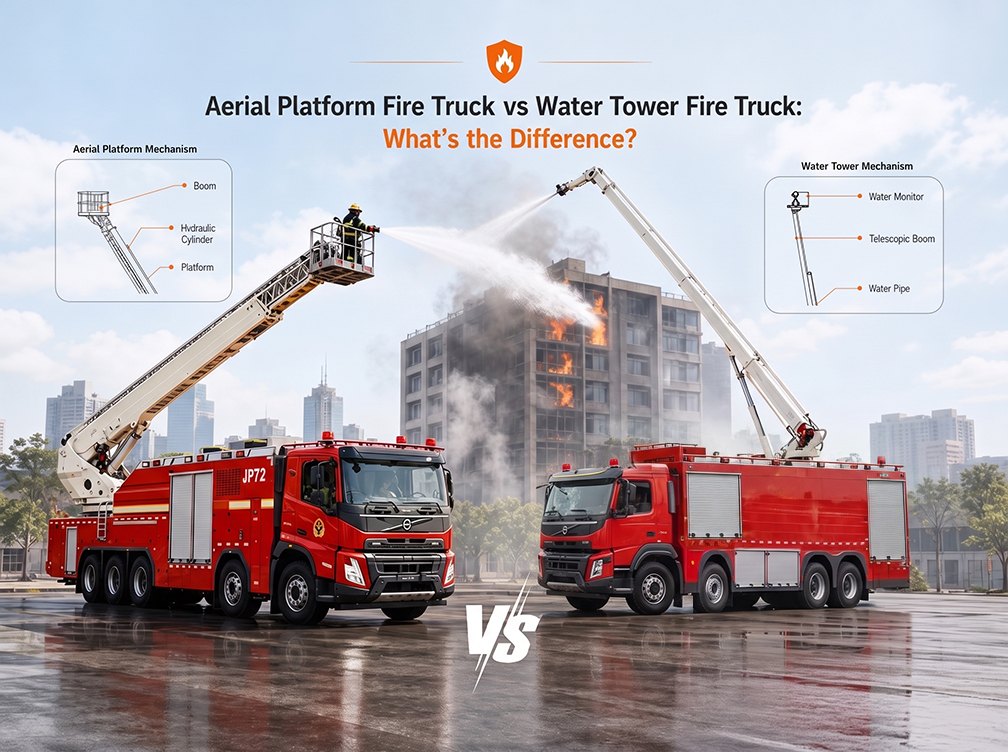
Dalam hal memadamkan kebakaran di gedung bertingkat tinggi, fasilitas industri, atau gudang besar, truk pemadam kebakaran udara sangat penting. Namun, di antara berbagai jenis kendaraan pemadam kebakaran udara, ada dua yang sering membingungkan: truk pemadam kebakaran platform udara dan truk pemadam kebakaran menara air. Meskipun sekilas tampak serupa—keduanya memiliki boom hidraulik dan dirancang untuk pemadaman kebakaran di ketinggian—keduanya menjalankan misi yang pada dasarnya berbeda. Artikel ini menguraikan perbedaan utama antara kedua jenis kendaraan ini, membantu para profesional layanan pemadam kebakaran, manajer pengadaan, dan distributor peralatan membuat keputusan berdasarkan kebutuhan operasional. I. Apa Itu Truk Platform Udara? Menurut standar nasional Tiongkok GB 7956.12-2015, kedua kendaraan ini termasuk dalam kategori kendaraan pemadam kebakaran udara—kendaraan yang dilengkapi boom pengangkat, meja putar, dan peralatan pemadam kebakaran untuk operasi di ketinggian. Namun, definisi spesifiknya menunjukkan perbedaan penting. Truk Pemadam Kebakaran Platform Udara Truk pemadam kebakaran platform udara dilengkapi dengan boom kombinasi lipat atau lipat-teleskopik, platform personel, meja putar, dan perangkat pemadam kebakaran.Fitur penentunya adalah platform kerja (keranjang) di ujung boom, tempat petugas pemadam kebakaran dapat berdiri untuk melakukan operasi penyelamatan dan pemadaman kebakaran .Karakteristik utama:• Dilengkapi dengan platform yang dapat membawa personel dan peralatan seberat 750 lbs hingga lebih dari 1.500 lbs• Dirancang untuk penyelamatan dan pemadaman kebakaran—petugas pemadam kebakaran dapat beroperasi langsung dari platform• Platform dapat digunakan dengan perangkat pengendali penurunan, derek hidraulik, atau seluncuran penyelamatan• Jangkauan horizontal yang lebih luas dan rentang kerja yang lebih besar dibandingkan menara air II. Apa Itu Truk Pemadam Kebakaran Menara Air? Truk pemadam kebakaran menara air dilengkapi dengan boom kombinasi lipat atau lipat-teleskopik, meja putar, dan perangkat pemadam kebakaran—tanpa platform personel. Sebagai gantinya, monitor pemadam (meriam air) dipasang di ujung boom, yang dapat dikendalikan dari jarak jauh dari permukaan tanah. Karakteristik utama:• Tidak ada platform personel—petugas pemadam kebakaran beroperasi dari permukaan tanah melalui kendali jarak jauh• Berfokus secara eksklusif pada pemadaman kebakaran di ketinggian, bukan penyelamatan• Menghasilkan aliran air yang sangat tinggi—melebihi 2.000 galon per menitpada banyak model industri• Dirancang untuk perlindungan kebakaran industri di mana kemampuan penyelamatan tidak diperlukan III. Perbandingan Berdampingan Fitur Truk Pemadam Kebakaran Platform Udara Truk Pemadam Kebakaran Menara Air Fungsi Utama Penyelamatan + pemadaman kebakaran Hanya pemadaman kebakaran Peralatan Ujung Lengan Platform kerja (keranjang) untuk personel Monitor pemadam kebakaran (meriam air) Personel di Lengan Ya—petugas pemadam kebakara...
Detail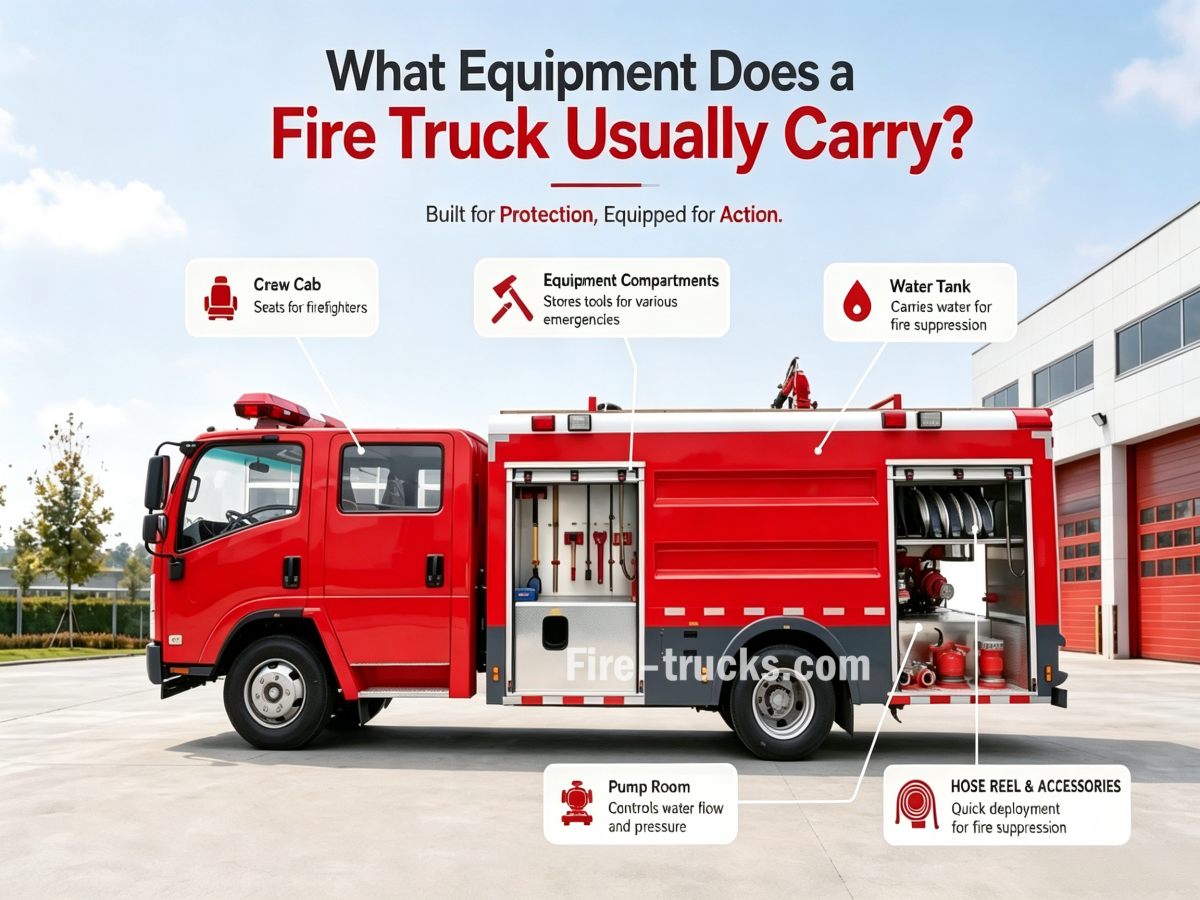
Sebuah truk pemadam kebakaran biasanya membawa peralatan pemadaman kebakaran, pasokan air, penyelamatan, dan perlindungan keselamatan. Peralatan umum mencakup pompa kebakaran, tangki air, selang kebakaran, nosel kebakaran, monitor kebakaran, katup, tangga kebakaran, alat penyelamatan, perlengkapan pelindung, dan perangkat komunikasi. Artikel ini secara sistematis menguraikan klasifikasi, fungsi, dan pertimbangan pemilihan standar peralatan truk pemadam kebakaran , membantu profesional pengadaan dan pengguna akhir membangun pemahaman lengkap tentang konfigurasi kendaraan pemadam kebakaran. I. Klasifikasi Peralatan Truk Pemadam Kebakaran 1. Peralatan Pemadaman Kebakaran— Alat inti untuk pemadaman api secara langsung, termasuk nosel kebakaran, monitor kebakaran, selang kebakaran, pembagi air, dan adaptor. 2. Peralatan Penyelamatan dan Pembobolan Akses— Alat untuk membuat jalur akses bagi operasi penyelamatan dan pemadaman kebakaran, termasuk alat penyelamatan hidraulik, kapak kebakaran, batang congkel, linggis, gergaji potong, dan gergaji mesin. 3. Peralatan Penyelamatan dan Penyedia Kehidupan— Peralatan untuk pencarian, pemindahan, dan perlindungan personel, termasuk tandu, tali penyelamatan, kait pengaman, perangkat pengendali penurunan, alat bantu pernapasan mandiri (SCBA), dan tabung udara cadangan. 4. Peralatan Pembuangan Asap dan Penerangan— Peralatan untuk meningkatkan kondisi lokasi kebakaran, termasuk alat penghisap asap, menara penerangan bergerak, dan lampu sorot pencarian intensitas tinggi portabel. 5. Alat Pelindung Diri (APD)— Perlengkapan untuk melindungi keselamatan petugas pemadam kebakaran, termasuk helm, pakaian pelindung pemadam kebakaran struktural, sarung tangan, sepatu bot, dan sabuk pengaman. 6. Peralatan Komunikasi dan Pengintaian— Peralatan untuk pengumpulan informasi di lokasi kebakaran dan koordinasi komando, termasuk radio dua arah, kamera pencitraan termal, dan detektor gas beracun. II. Peralatan Pemadaman Kebakaran pada Truk Pemadam Kebakaran 1. Pompa Kebakaran Pompa kebakaran adalah sumber tenaga untuk semua operasi pemadaman kebakaran. Pompa ini secara mekanis memberi tekanan pada air, memberikan energi kinetik yang cukup untuk menyelesaikan seluruh proses "penyedotan → pemberian tekanan → pengaliran → pembuangan." Spesifikasi umum pompa kebakaran: • Pompa Kebakaran Tekanan Standar (tipe CB10/30):Laju aliran ≥30L/dtk, tekanan nominal 1,0MPa, pemasangan di bagian belakang. Cocok untuk kendaraan tangki air standar dan truk pemadam kebakaran busa, memenuhi sebagian besar kebutuhan pasokan air pemadaman kebakaran di perkotaan dan industri. • Pompa Kebakaran Tekanan Menengah/Tinggi:Aliran tekanan rendah 30L/dtk pada 1,0MPa, aliran tekanan tinggi 20L/dtk pada 2,0MPa, pemasangan di bagian belakang. Desain tekanan ganda mendukung pasokan volume besar (tekanan rendah) dan pengaliran jarak jauh/ketinggian tinggi (tekanan tinggi) dalam satu pompa. Ideal untuk truk pemadam kebakaran utama perkotaan dan skenario pemadaman kebakar...
Detail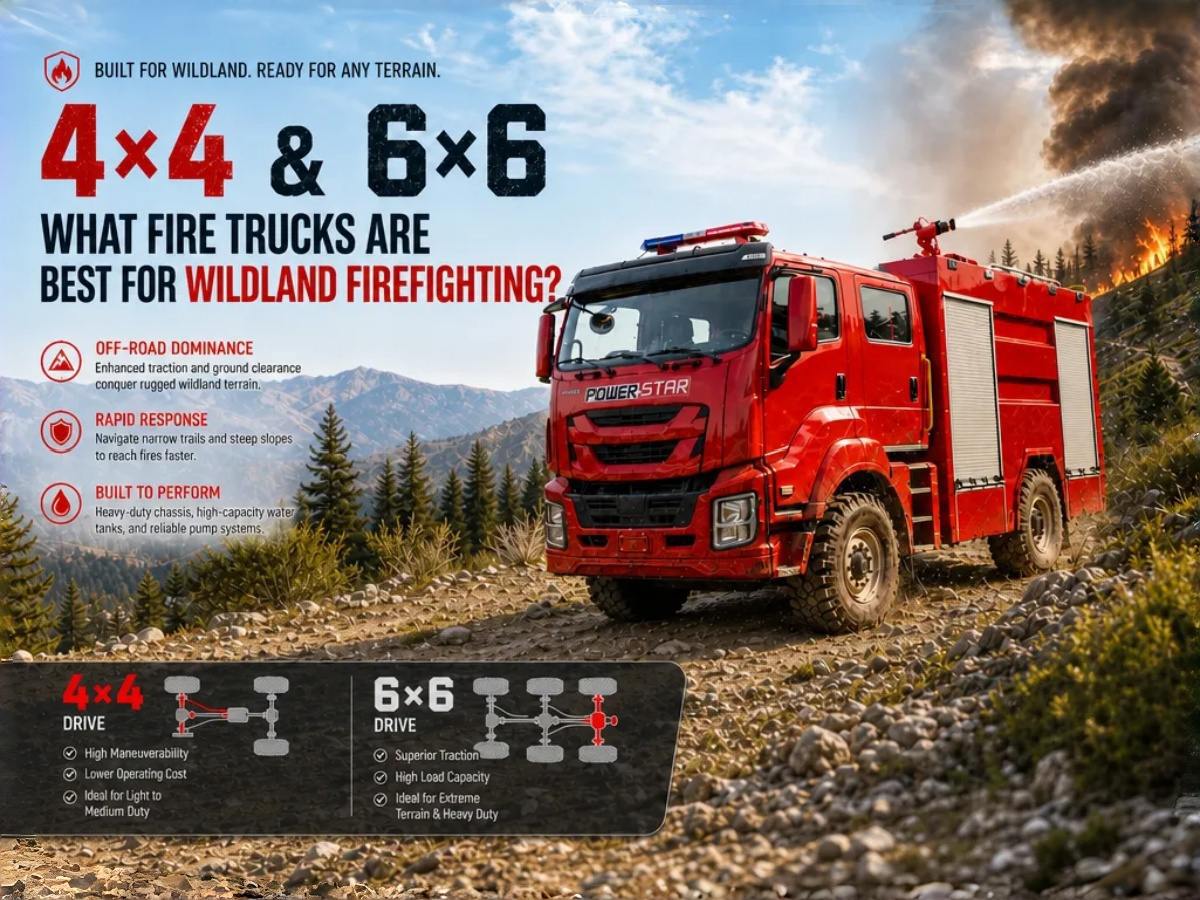
Pemadaman kebakaran hutan menghadirkan tantangan yang secara mendasar berbeda dari pemadaman kebakaran bangunan. Di hutan terpencil, padang rumput, dan medan pegunungan, truk pemadam kebakaran harus melewati jalur sempit, menaiki lereng curam, dan beroperasi jauh dari hidran atau sumber air. Memilih truk pemadam kebakaran yang tepat merupakan keputusan strategis yang secara langsung berdampak pada waktu respons, keselamatan kru, dan efektivitas penanggulangan kebakaran. Artikel ini memberikan ulasan komprehensif mengenai jenis truk pemadam kebakaran yang paling sesuai untuk pemadaman kebakaran hutan, fitur utamanya, dan metode pemilihan, sehingga membantu Anda membuat keputusan yang tepat berdasarkan kebutuhan operasional spesifik Anda. Jawaban Singkat Kebakaran hutan ditandai dengan area kebakaran yang luas, medan yang kompleks, sumber air yang terbatas, dan kondisi jalan yang buruk, sehingga tidak ada satu jenis truk pemadam kebakaran yang dapat menangani semua skenario kebakaran hutan. Secara umum, pemadaman kebakaran hutan terutama menggunakan jenis truk pemadam kebakaran berikut: • Truk pemadam kebakaran hutan ringan: untuk akses jalan hutan dan respons cepat• Truk pemadam kebakaran hutan off-road 4×4: untuk medan pegunungan dan perbukitan• Truk pemadam kebakaran hutan 6×6: untuk kebakaran hutan berskala besar dan operasi berkepanjangan• Truk tangki air: untuk pasokan air berkelanjutan dan dukungan• Truk pemadam kebakaran busa: untuk fasilitas minyak, peralatan hutan, atau kebakaran khusus• Kendaraan penyelamat: untuk komunikasi, penerangan, pembukaan akses, dan dukungan logistik I. Mengapa Kebakaran Hutan Memerlukan Truk Pemadam Kebakaran Khusus? Kebakaran hutan berbeda secara mendasar dari kebakaran bangunan dalam beberapa aspek penting: Karakteristik utama kebakaran hutan:• Area kebakaran luas yang mencakup hektare lahan• Arah angin yang berubah dengan cepat• Medan yang kompleks dan berat• Akses terbatas atau tidak ada akses ke hidran maupun sumber air• Jalan hutan yang sempit dan tidak beraspal• Kondisi komunikasi yang sulit Truk pemadam kebakaran perkotaan standar umumnya tidak cocok untuk pemadaman kebakaran hutan karena alasan berikut: •Tidak memiliki penggerak 4×4 atau penggerak semua roda untuk jalan pegunungan yang tidak beraspal dan lereng curam;•Ukuran yang lebih besar dan jarak bebas tanah yang rendah membuatnya mudah terjebak di jalur hutan sempit dan medan lunak;•Pompa perkotaan mengutamakan aliran tinggi pada tekanan sedang, sedangkan operasi pemadaman hutan memerlukan tekanan tinggi melalui bentangan selang panjang dengan air terbatas—pendekatan yang secara mendasar berbeda. II. Jenis Umum Truk Pemadam Kebakaran Hutan Jenis Truk Pemadam Kebakaran Karakteristik Utama Skenario yang Dapat Diterapkan Truk Pemadam Kebakaran Hutan Ringan Mobilitas tinggi, ukuran ringkas Patroli hutan, serangan awal Truk Pemadam Kebakaran Hutan 4x4 Kemampuan off-road yang kuat Medan pegunungan dan perbukitan Truk Pemadam Kebakaran Hutan 6x6 Kapas...
Detail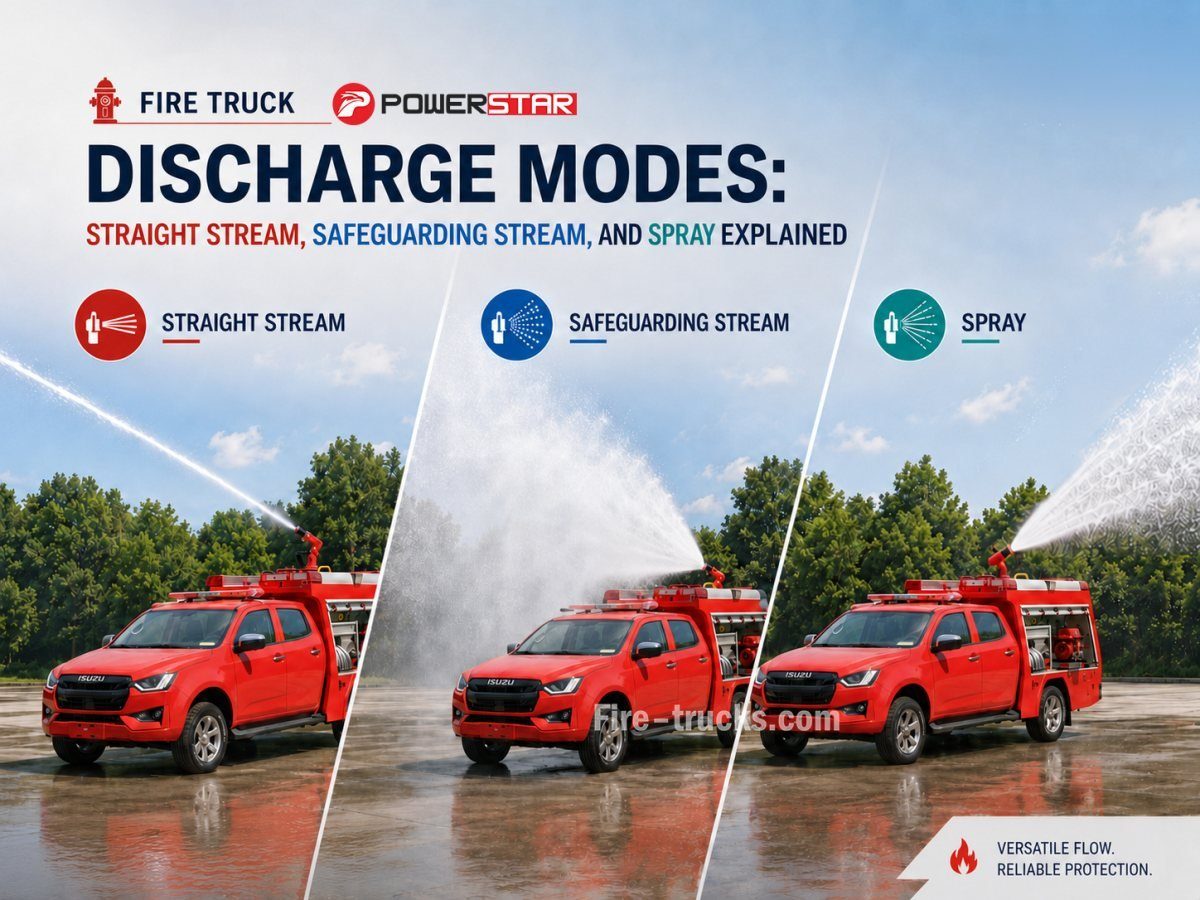
Dalam operasi pemadaman kebakaran, pemilihan mode pancaran secara langsung menentukan efisiensi pemadaman api, keselamatan operasional, dan efektivitas pengendalian kebakaran. Kebanyakan orang tidak menyadari bahwa truk pemadam kebakaran nozel dapat beralih di antara tiga mode pancaran utama: pancaran lurus, pancaran semprot, dan pancaran perlindungan. Mode yang berbeda memiliki variasi signifikan dalam pola aliran, jangkauan, gaya benturan, dan area cakupan, serta masing-masing sesuai dengan skenario kebakaran yang sepenuhnya berbeda. Artikel ini, berdasarkan standar operasi pemadaman kebakaran profesional, menganalisis secara menyeluruh prinsip, karakteristik utama, dan skenario penerapan dari tiga mode pancaran, membantu pelanggan kami menguasai teknik pancaran truk pemadam kebakaran secara sistematis. I. Mengapa Truk Pemadam Kebakaran Membutuhkan Mode Pancaran yang Berbeda? Pancaran lurus, pancaran semprot, dan pancaran perlindungan masing-masing berhubungan dengan tiga mekanisme pemadaman api yang berbeda: pemadaman melalui benturan, pencekikan melalui penguapan, dan perlindungan dari radiasi panas. Petugas pemadam kebakaran harus beralih secara fleksibel sesuai kondisi lokasi. Jadi, mengapa kita tidak bisa terus menggunakan hanya satu jenis pancaran? 1. Keberagaman jenis kebakaran membutuhkan bentuk media pemadam yang berbeda Jenis kebakaran yang berbeda memiliki karakteristik pembakaran yang berbeda, yang menentukan metode pemadaman yang sesuai: • Kebakaran material padat Kelas A memerlukan benturan pancaran lurus untuk memecah material yang terbakar dan menembusnya untuk pendinginan internal; • Kebakaran cairan Kelas B tidak dapat menggunakan benturan pancaran lurus (yang menyebabkan percikan dan memperluas kebakaran), tetapi harus menggunakan pancaran perlindungan atau pancaran semprot untuk penutupan dan pengenceran; • Kebakaran listrik bertegangan Kelas E hanya dapat menggunakan pancaran semprot, karena tetesan air halus tidak membentuk jalur penghantar listrik yang kontinu; • Kebakaran ruang tertutup memerlukan pancaran semprot untuk memenuhi seluruh ruang, mencapai pemadaman melalui penyerapan panas penguapan dan pencekikan. Tidak ada satu mode pun yang dapat menyesuaikan diri dengan semua jenis kebakaran. 2. Tahapan berbeda dari kebakaran yang sama membutuhkan pendekatan taktis yang berbeda Bahkan untuk kebakaran yang sama, tahapan yang berbeda memerlukan mode pancaran yang berbeda: • Pada tahap awal ketika api sangat kuat, pancaran lurus diperlukan untuk memberikan benturan jarak jauh pada titik api guna penekanan cepat; • Selama proses maju, pancaran perlindungan diperlukan untuk membentuk penghalang tirai air yang menghalangi radiasi panas dan melindungi personel; • Sebelum memasuki ruangan, pancaran semprot diperlukan untuk mendinginkan dan mengencerkan asap serta gas, menciptakan kondisi untuk serangan dari dalam. Satu mode saja tidak dapat mencakup kebutuhan operasional selama seluruh proses pemadaman kebakaran. 3. Jangkauan, ...
Detail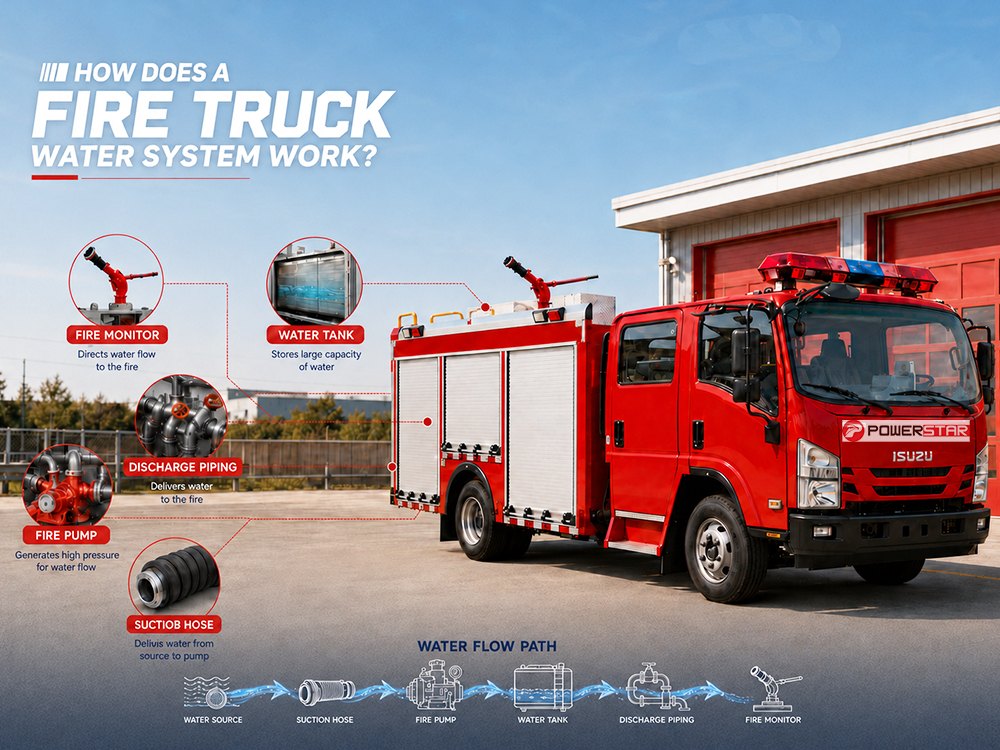
Sistem perpipaan air truk pemadam kebakaran adalah inti dari setiap operasi pemadaman kebakaran. Sistem ini secara presisi mengarahkan air dari tangki atau sumber eksternal melalui pompa, katup, dan pipa untuk mengalirkan air bertekanan tinggi atau busa ke lokasi kebakaran — baik itu kebakaran gedung tinggi di pusat kota yang padat maupun kebakaran tangki penyimpanan petrokimia di zona industri. truk pemadam kebakaran sistem perpipaan air terdiri dari beberapa komponen yang bekerja bersama: pompa pemadam kebakaran, tangki air, selang hisap, pipa pembuangan, katup, sambungan pembagi, sambungan pengumpul, saringan, monitor pemadam kebakaran, kopling selang, dan lainnya. Jalur aliran lengkap adalah: Tangki Air → Selang Hisap → Saringan → Pompa Pemadam Kebakaran → Sistem Pengaturan Tekanan → Manifold Pembuangan → Katup → Sambungan Pembagi → Monitor Pemadam Kebakaran / Kopling Selang → Nosel Artikel ini menjelaskan setiap komponen sistem perpipaan air dan bagaimana komponen tersebut bekerja bersama untuk mengalirkan air dengan tekanan dan aliran yang tepat. I. Komponen Inti Sistem Perpipaan Air Tangki Air Menyimpan pasokan air di dalam kendaraan. ● Kapasitas: Biasanya 2.000–12.000 liter. ● Penyaluran: Menyuplai pompa melalui pipa masuk. ● Fitur: Sekat anti-guncangan air untuk stabilitas kendaraan, saringan untuk menyaring kotoran, dan sistem pengisian awal untuk mengambil air dari sumber air alami. Pompa Pemadam Kebakaran Pompa sentrifugal yang digerakkan oleh mesin truk melalui PTO; satu tahap/multi tahap, berbahan besi cor atau perunggu. ● Kelas tekanan: Tersedia dalam peringkat standar 0,8 MPa, 1,0 MPa, 1,2 MPa, dan 1,4 MPa, sesuai dengan kebutuhan pemadaman kebakaran umum. ● Laju aliran: Berkisar dari 1.200 hingga 6.000 L/menit, dengan kurva kinerja yang dioptimalkan untuk operasi bertekanan tinggi maupun bervolume besar. Katup dan Perpipaan Jaringan pipa dan katup yang mengendalikan arah dan volume aliran air. ● Katup masuk: Menghubungkan pompa ke sumber air eksternal (hidran atau titik pengambilan air) ● Katup tangki-ke-pompa: Memungkinkan pompa mengambil air langsung dari tangki yang tersedia di kendaraan ● Katup pembuangan: Mengendalikan aliran air ke selang dan nosel II. Cara Kerja Sistem Perpipaan Air Truk Pemadam Kebakaran Langkah 1: Pengambilan Air dan Pengisian Awal Air masuk ke dalam sistem dari tangki yang tersedia di kendaraan, hidran pemadam kebakaran, atau sumber air alami (danau, sungai, kolam). Saat mengambil air dari sumber alami, sistem pengisian awal (pompa vakum) mengeluarkan udara dari selang hisap, menciptakan ruang hampa yang memungkinkan tekanan atmosfer mendorong air masuk ke pompa. Saringan menyaring kotoran untuk melindungi pompa, dan katup satu arah mencegah aliran balik. Langkah 2: Beri Tekanan pada Pompa Pompa sentrifugal digerakkan oleh mesin truk melalui power take-off (PTO). Setelah air mengisi pompa, impeler berputar pada kecepatan tinggi (1.500–2.500 RPM). Gaya sentrifugal melemparkan air ke arah luar, meningkat...
Detail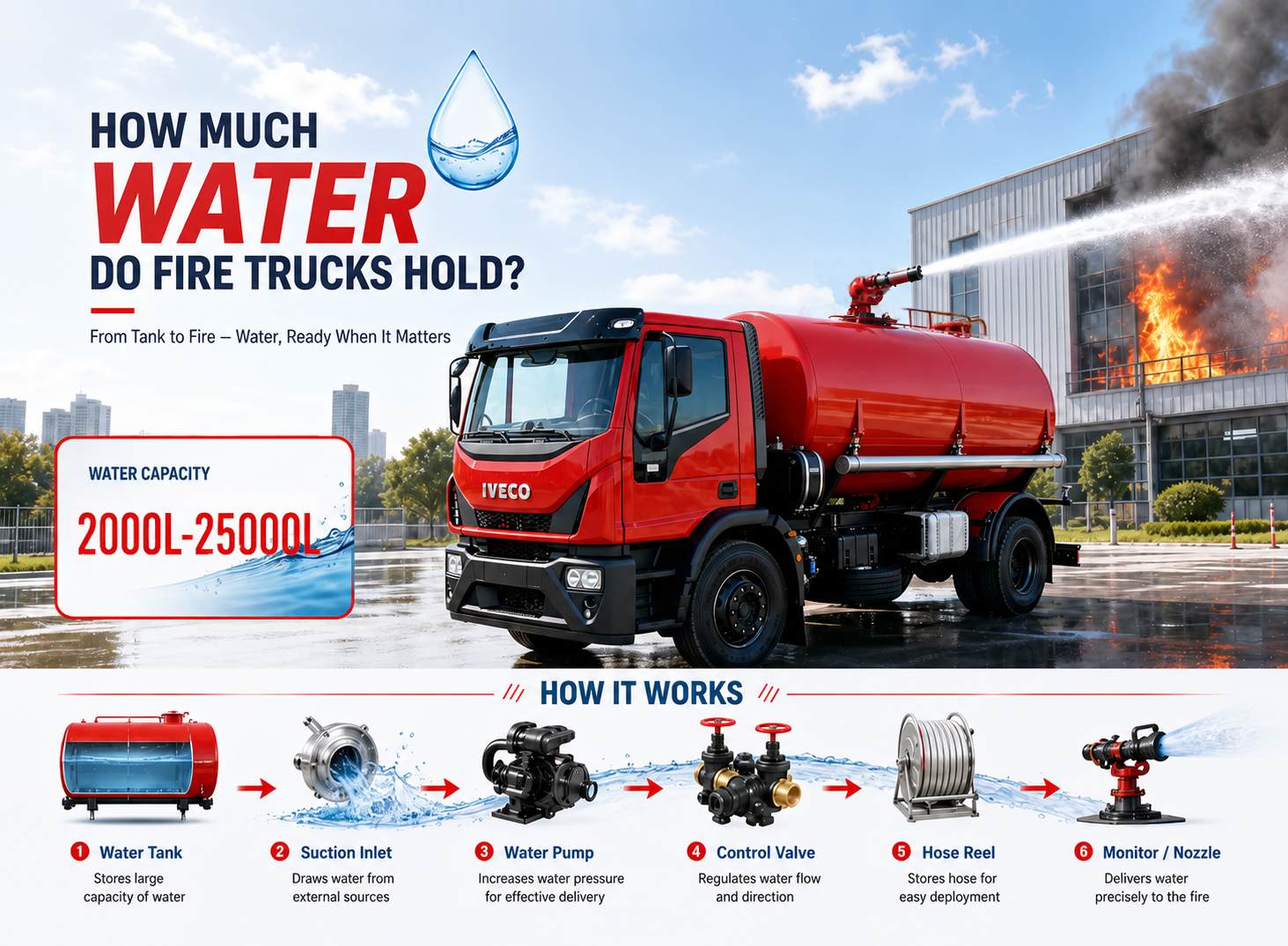
Berapa banyak air yang dapat dibawa oleh mobil pemadam kebakaran? Ini adalah salah satu pertanyaan pertama yang dihadapi pelanggan kami saat memilih mobil pemadam kebakaran. Tidak ada angka tetap tunggal — hal ini bergantung pada jenis kendaraan, kapasitas sasis, tujuan desain, dan peraturan regional, mulai dari unit tugas ringan berkapasitas 2.000 liter hingga mobil pemadam kebakaran industri berkapasitas 25.000 liter. Namun, tangki yang lebih besar tidak selalu berarti kinerja yang lebih baik;kendaraan pemadam kebakaran kapasitas tangki air harus disesuaikan dengan tepat dengan laju aliran pompa, laju pelepasan monitor, dan kapasitas sasis untuk memberikan hasil pemadaman kebakaran yang efektif. Artikel ini dimulai dengan dasar-dasar kapasitas tangki air mobil pemadam kebakaran, menganalisis rentang penyimpanan umum untuk berbagai jenis kendaraan, mengkaji faktor-faktor utama yang memengaruhi desain tangki, dan memberikan panduan pembelian yang praktis. Poin Utama: Kapasitas tangki air mobil pemadam kebakaran biasanya berkisar antara 2.000 hingga 25.000 liter Berbagai jenis mobil pemadam kebakaran memiliki kapasitas tangki yang berbeda Tangki yang lebih besar tidak berarti kemampuan pemadaman kebakaran yang lebih baik Kapasitas tangki harus disesuaikan dengan aliran pompa, aliran monitor, dan kapasitas sasis Pemadaman kebakaran industri biasanya memerlukan tangki besar, sedangkan pemadaman kebakaran kota memprioritaskan kemampuan manuver » I. Tiga Jenis Dasar Tangki Air Mobil Pemadam Kebakaran Mobil Pompa:Ini adalah mobil pemadam kebakaran kota yang paling umum. Kendaraan ini terutama mengandalkan hidran kebakaran untuk pasokan air dan membawa sekitar 1.900–3.800 liter air di dalam kendaraan untuk serangan awal. Inti dari kendaraan ini adalah pompa, bukan tangki — kendaraan ini dirancang untuk mengalirkan air bertekanan setelah terhubung ke hidran. Mobil Tangki (Pengangkut Air):Kendaraan ini didedikasikan untuk mengangkut air dalam jumlah besar, dengan kapasitas tangki biasanya melebihi 11.400 liter. Kendaraan ini memainkan peran penting di daerah pedesaan dan terpencil yang tidak memiliki hidran kebakaran, dengan mengangkut air dari sumber air ke lokasi kebakaran untuk digunakan oleh mobil pompa. Mobil Pompa-Tangki:Kendaraan ini menggabungkan fungsi pemompaan dan pengangkutan air dalam satu unit. Kendaraan ini dapat mengalirkan air untuk pemadaman kebakaran sekaligus memasok kendaraan lain. Kapasitas tangki biasanya berkisar antara 5.700 hingga 11.400 liter, menjadikannya solusi serbaguna bagi departemen pemadam kebakaran. » II. Berapa Banyak Air yang Dapat Dibawa Berbagai Jenis Mobil Pemadam Kebakaran? Jenis Mobil Pemadam Kebakaran Kapasitas Tangki Umum Aplikasi Utama Mobil pemadam kebakaran tugas ringan 2.000–3.000 L Respons cepat perkotaan, serangan awal Mobil pompa kota 3.000–6.000 L Pemadaman kebakaran kota, kebakaran struktur Mobil pompa tugas menengah 6.000–10.000 L Tugas gabungan perkotaan dan industri Mobil pompa tugas berat 10.000–15...
Detail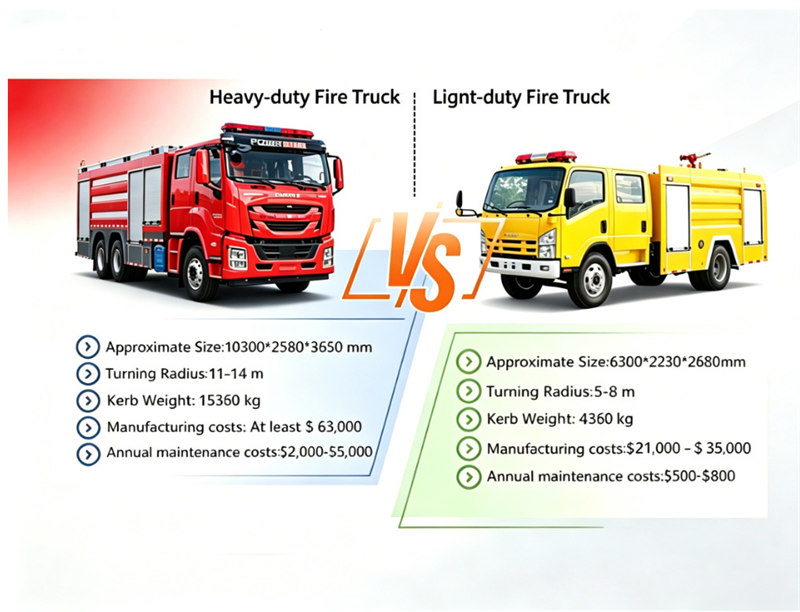
Truk pemadam kebakaran penyelamatKebutuhan bervariasi secara drastis antara wilayah metropolitan dan komunitas pedesaan atau kota kecil. Dinas pemadam kebakaran perkotaan besar mengandalkan truk pemadam kebakaran tugas berat dengan tangki air berkapasitas besar, tangga tinggi untuk gedung bertingkat, dan konfigurasi lengkap berstandar industri untuk menangani kebakaran gedung bertingkat, kebakaran industri, dan keadaan darurat berskala besar. Namun, untuk kota kecil, daerah pedesaan, stasiun pemadam kebakaran desa, dan dinas pemadam kebakaran sukarela, truk pemadam kebakaran berat sering kali menjadi lebih sebagai beban daripada keuntungan. Inilah alasan mengapa truk pemadam kebakaran ringan telah menjadi solusi arus utama dan paling praktis bagi dinas pemadam kebakaran kota kecil dan pedesaan di seluruh dunia. Dengan menyeimbangkan ukuran yang ringkas, mobilitas fleksibel, fungsi penyelamatan dasar yang lengkap, dan biaya keseluruhan yang rendah, kendaraan ini sangat sesuai dengan kebutuhan penyelamatan harian dan pencegahan kebakaran bagi tim pemadam kebakaran tingkat akar rumput. Truk pemadam kebakaran ringan adalah kendaraan darurat pemadam kebakaran yang ringkas dan ringan, dirancang khusus untuk skenario kebakaran tingkat akar rumput, pinggiran kota, dan pedesaan. I. Perbandingan antara truk pemadam kebakaran tugas berat dan truk pemadam kebakaran ringan: Untuk melihat dengan jelas kesenjangan antara truk pemadam kebakaran tugas berat dan ringan, kami telah menyiapkan bagan perbandingan langsung yang mencakup metrik praktis utama. Model berat memiliki panjang lebih dari 10 meter dengan radius putar 11–14 m dan berat kosong 15 ton, dengan biaya pembuatan setidaknya $63.000 ditambah biaya perawatan tahunan $2.000–$5.000. Sebaliknya, truk pemadam kebakaran ringan yang ringkas mengurangi dimensi hampir setengahnya, hanya berbobot 4.360 kg, mulai dari harga $21.000, dan menjaga biaya perawatan tahunan di bawah $800, memberikan mobilitas serta nilai anggaran yang jauh lebih baik untuk stasiun pemadam kebakaran pedesaan dan kota kecil. Ⅱ.Sorotan utama truk pemadam kebakaran ringan: 1.Desain ringan namun berdaya angkut tinggi. Berat kendaraan kotor total tetap di bawah 8.000 kg bahkan saat terisi penuh, memungkinkan respons darurat yang sangat cepat. 2.Kustomisasi penggerak semua roda tersedia untuk menghadapi permukaan jalan kasar dan tidak rata yang umum di wilayah terpencil. 3.Fungsi pemadaman kebakaran menyeluruh tetap dipertahankan sepenuhnya: a. Tangki ganda independen untuk air dan busa pemadam kebakaran. b. Kabin kru dua baris untuk menampung seluruh tim petugas pemadam kebakaran yang merespons. c. Inventaris standar lengkap berisi peralatan penyelamatan darurat dan pemadaman kebakaran. d. Tambahan opsional termasuk sistem pencahayaan lokasi kejadian dan peralatan penarik. 4.Sistem power take-off (PTO) berfungsi sebagai penggerak operasi inti. Sistem ini memiliki kontrol intuitif serta perawatan dan penggantian kompo...
Detail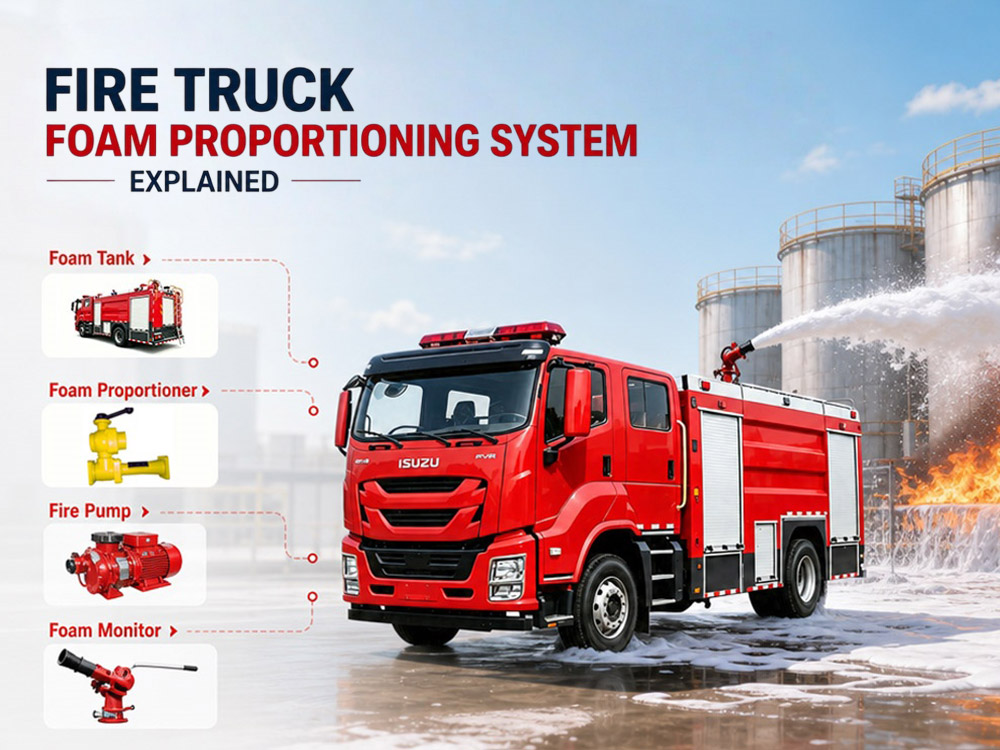
Sistem busa truk pemadam kebakaran mencampurkan air dengan konsentrat busa pada rasio yang tepat (1%, 3%, atau 6%) untuk membuat larutan busa. Larutan ini kemudian diberi tekanan oleh pompa pemadam kebakaran dan dikembangkan dengan udara melalui nosel busa — ini adalah prinsip kerja inti dari cara sebuah truk pemadam kebakaran busa mencampurkan busa dan air — yang pada akhirnya menghasilkan lapisan busa stabil yang menutupi permukaan bahan bakar. Proses ini meningkatkan efisiensi pemadaman kebakaran lebih dari 50% sekaligus mengurangi pemborosan konsentrat busa sebesar 30%. » I. Mengapa Truk Pemadam Kebakaran Membutuhkan Sistem Busa? Dibandingkan dengan hanya menggunakan air, busa menawarkan tiga keunggulan utama: 1. Isolasi Oksigen— Busa menutupi permukaan yang terbakar, membentuk penghalang fisik padat yang mencegah oksigen mencapai zona pembakaran, sehingga memadamkan api. 2. Penurunan Suhu— Kandungan air dalam larutan busa menyerap sejumlah besar panas saat menguap, sehingga dengan cepat menurunkan suhu area yang terbakar. 3. Pencegahan Penyalaan Kembali— Lapisan busa terus menutupi area kebakaran bahkan setelah pemadaman, secara efektif mengisolasi oksigen dan uap yang mudah terbakar, sehingga secara signifikan mengurangi risiko penyalaan kembali. » II. Prinsip Kerja Inti Sistem Busa 1. Sistem Proporsi:Air mengalir melalui alat proporsi → menciptakan tekanan negatif (sistem tekanan negatif) atau menggunakan pompa busa (sistem tekanan positif) → menarik konsentrat busa dari tangki busa → mencampur pada rasio yang telah ditetapkan (1%, 3%, atau 6%) → larutan busa mengalir ke pompa. 2. Pemberian Tekanan oleh Pompa:Larutan busa masuk ke pompa sentrifugal → diberi tekanan hingga 0,8–1,2 MPa → dialirkan melalui pipa ke saluran keluar atau monitor busa. 3. Pengembangan Busa:Larutan busa bertekanan melewati nosel busa atau perangkat aerasi → udara masuk terbawa → larutan mengembang menjadi busa jadi → menutupi permukaan bahan bakar → memutus oksigen dan memadamkan api. Konsep Utama: Konsentrat busa + air tidak sama dengan busa jadi. Larutan busa yang telah dicampur masih berupa cairan — larutan ini harus digabungkan dengan udara melalui nosel busa agar menjadi busa pemadam kebakaran yang sebenarnya. Ketika larutan busa bertekanan tinggi melewati nosel dengan kecepatan tinggi, larutan tersebut menciptakan zona tekanan negatif lokal yang secara paksa menarik udara masuk. Udara dan cairan bertabrakan serta mengalami geseran kuat di dalam nosel, langsung terpecah menjadi jutaan gelembung kecil yang terkumpul membentuk busa putih. » III. Bagaimana Truk Pemadam Kebakaran Mencampur Busa dan Air? Proses pencampuran busa pada truk pemadam kebakaran terdiri dari empat langkah utama, mulai dari pasokan air hingga pembentukan busa akhir. Langkah 1: Pompa Pemadam Kebakaran Menyediakan Aliran Air Setelah truk pemadam kebakaran dinyalakan, pompa pemadam kebakaran menyediakan tenaga untuk sistem busa. Sumber air dapat mencakup tangki bawaan, hidran kebakaran, sunga...
Detail
Silakan baca terus, tetap ikuti perkembangannya, berlangganan, dan kami menyambut baik pendapat Anda.

 Jaringan IPv6 didukung

 Indonesia
  English
 français
 Deutsch
 русский
 italiano
 español
 português
 Nederlands
 العربية
 日本語
日本語 한국의
한국의 Türkçe
 Melayu
 ไทย
ไทย Tiếng Việt
 中文
中文 қазақ
қазақ Filipino
 မြန်မာ
 српски